Our team consists of over 150 years of experience in so many industries, we’ve lost count. Read their takes on important conversations and topics below.

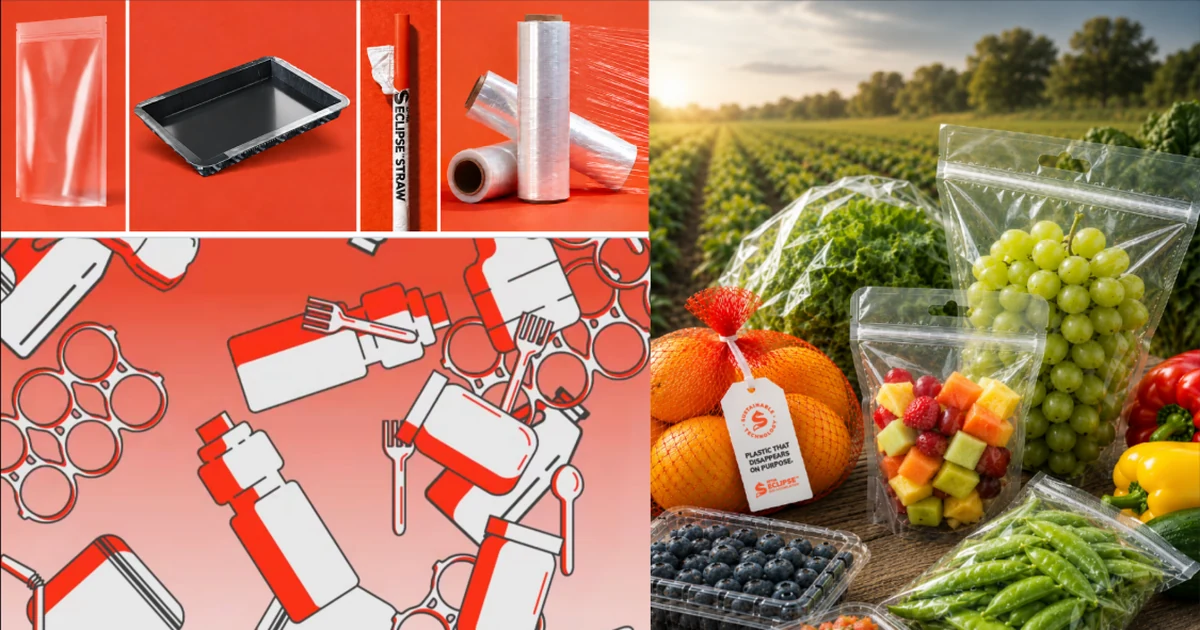
A look at SPTek ECLIPSE®, a 1% polyolefin additive built to give plastic that won't be recycled a built-in exit plan.
Roughly 350 million tons of plastic reach the end of their life every year, and about a quarter of that is mismanaged — not recycled, not incinerated, not safely landfilled, just loose in the environment. A big share of it is polyolefins. Polyethylene and polypropylene, the workhorses behind stretch film, pouches, straws, and shopping bags, together make up something like 45% of everything the world produces as plastic. Most of it is exactly the kind of flexible packaging that recycling infrastructure struggles to touch.
I recently spoke with Yaman Peksenar, director of science and technology at Smart Plastic Technologies, about an additive called SPTek ECLIPSE® that's built for that gap — the plastic that, realistically, will not be recycled.
ECLIPSE gets mixed into polyolefin resin at about 1%, the same way a manufacturer would add colorant, or a masterbatch. Once blended in, it's invisible: no change to color, clarity, or how the plastic behaves in use. Inside that 1%, though, sits a catalyst paired with stabilizers whose entire job is to hold it in check.
That's the clever part. The stabilizers get consumed first, and only once they're used up does the catalyst go to work — so a manufacturer can dial in a product's functional shelf life, from about a year out to seven-plus. The formulation is built to preserve the product through its working life before the next stage begins; something like a stretch-wrap film gets tuned for a shorter run, a piece of rigid tableware for a longer one, with the exact timing set by the product and its conditions of use. Heat and UV exposure at end of life finally wake the catalyst up, and moisture afterward gets biofilm growing on the surface.
From there, it's an oxidation reaction. The catalyst cuts the plastic's long carbon backbone into shorter and shorter pieces — company data describes the molecular weight stepping down from around 200,000 to roughly 5,000 and below, the point at which microbes stop treating the material as inert and start treating it as a food source. Continue that far enough and the plastic's carbon converts, at the molecular level, into CO2, water, and biomass — how far and how fast depends on the conditions it's breaking down in.
The claims aren't just a company brochure. Smart Plastic has run its ECLIPSE-treated film through a stack of third-party labs:
Smart Plastic secured a U.S. patent in June 2026 on specific ECLIPSE masterbatch formulations. “An issued patent is an important milestone for Smart Plastic and for SPTek Eclipse,” Yaman told PlasticsToday when it came through, pointing to the years of USPTO examination behind it. Colleague Robin Misir, VP of operations, described the skepticism Smart Plastic runs into plainly: manufacturers considering the material tend to ask the same question first — is this real, or just another pending application? Today, Smart Plastic uses ECLIPSE in both flexible HDPE/LLDPE packaging and rigid, food-contact polypropylene.
Here's the part I found most reassuring: ECLIPSE isn't sold as competition for recycling. The pitch is closer to this — if you're recycling, great, keep doing it; if your product ends up in a landfill anyway, this is what you need. Before end-of-life triggers kick in, ECLIPSE-treated resin runs through standard mechanical recycling equipment just fine, and recyclers add their own stabilizers that make accidental activation even less likely. Post-consumer recycled content can be blended in alongside it, too, without giving up EPR credit.
The friction shows up elsewhere. Recycling guidelines currently prohibit additives like this one outright, and shifting that position means working through eco-modularity credits under emerging EPR legislation — a slow, expensive lobbying track. Against bio-based polyethylene (non-degradable, roughly triple the cost) or compostable resins (a 20%+ premium), ECLIPSE is a drop-in replacement at under a 5% cost bump with no production-line changes. ECLIPSE itself is already co-branded into a commercial stretch-wrap line, Sigma Vanish, built around the tagline: if you can't recycle it, make it vanish.
The economics favor adoption. The habit doesn't, yet — reformulating a cost-optimized supply chain is a hard sell until legislation or litigation makes the status quo more expensive than the change.
If your product's most likely ending is a landfill rather than a recycling bin, wouldn't you want the plastic itself carrying an exit plan?
This article originally appeared in Dr. John Skabardonis’s newsletter Tech Nuggets, which you may subscribe to here. John is the founder of Optimist Consulting and is a PhD chemist, keynote speaker, and Distinguished Toastmaster (DTM). He has spent decades making complex, technical ideas impossible to ignore. As a subject matter expert at the intersection of science, innovation, and sustainability, he explores where science and environmental responsibility is at the core of all activity every single day.
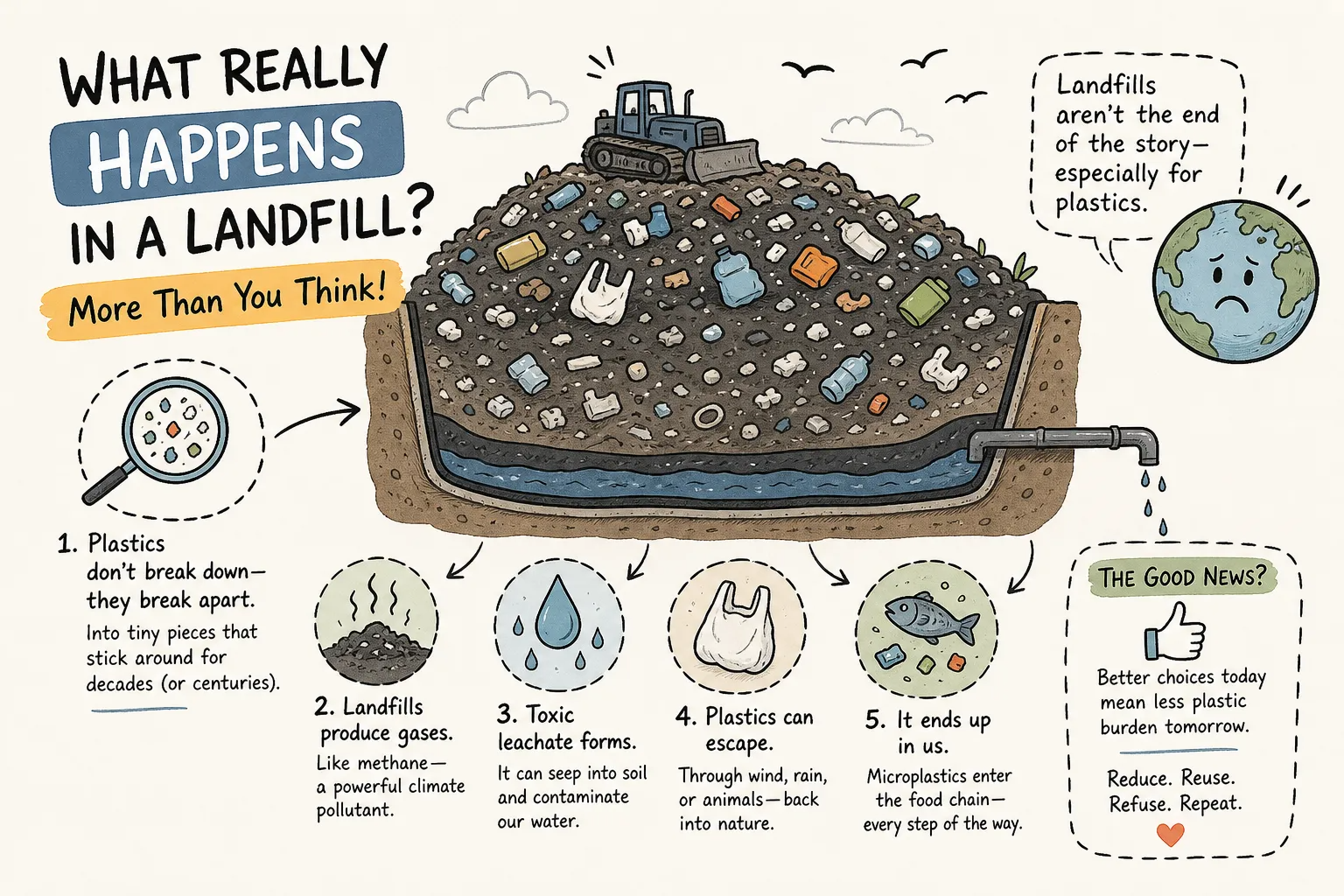
Modern landfills are engineered to contain waste, not transform it, which is why what happens to plastic underground is decided at the formulation stage.
Understanding how landfills work starts with recognizing that modern municipal solid waste landfills (MSWLFs) are precision-engineered containment systems, not open pits. They use layered liners, leachate collection pipes, gas extraction wells, and decades of post-closure monitoring to manage the slow chemical transformation of everything buried inside them. But understanding how that engineering works reveals something the system cannot solve on its own: what happens to individual plastic particles inside the waste mass is entirely a materials problem, one that begins at the formulation stage, not at the landfill gate.
The seven facts below move through landfill operations in sequence, from the moment a truck arrives to the question converters and brand owners ask us most: does your material choice today determine an environmental outcome decades from now? According to the EPA's most recent national waste data, roughly 50% of U.S. municipal solid waste ends up in landfills. That figure alone explains why the answer matters.
Disposal at a modern MSWLF begins at the scalehouse. The loaded truck crosses a certified weighbridge, its gross weight is recorded, and operators log the hauler, waste type, vehicle, and time. From there, an attendant directs the truck along internal roads to the permitted disposal area, called the working face. Operators keep that active area intentionally small to control litter, odors, and pests.
After the truck tips its load, personnel may inspect the exposed waste to identify prohibited or hazardous materials. A dozer then spreads the waste into controlled layers, typically about two feet thick, and a heavy compactor makes repeated passes to crush and consolidate the material. The empty truck returns to the scalehouse for an outbound tare weigh; the net weight difference is used for billing and regulatory reporting. At the end of the day, the compacted working face is covered with soil, foam, or approved tarps to limit odors, vectors, and windblown litter until operations resume.
The working face is the visible part of the operation. Beneath it, a modern sanitary landfill cell is a carefully sequenced stack of barriers and drainage systems. Starting from the prepared subgrade and moving upward: a secondary composite liner (typically an HDPE geomembrane over compacted clay), a leak-detection drainage layer, a primary composite liner, a leachate drainage layer with perforated collection pipes, and then protective soil before the waste mass itself.
That double-liner design functions as a redundant containment system. The primary liner contains leachate; the secondary layer captures anything that bypasses it. Both feed toward sumps where pumps remove liquid for treatment, discharge, or shipment to a wastewater facility. Associated systems include vertical gas wells, stormwater drainage, groundwater-monitoring wells, and access roads. This is the physical foundation that every piece of waste, including the packaging your customers put on retail shelves, eventually rests on.
Buried organic waste moves through two stages. First, aerobic microbes consume trapped oxygen and produce mostly carbon dioxide. Once oxygen depletes, anaerobic microorganisms take over, generating landfill gas (LFG), roughly 50% methane and 50% carbon dioxide, plus trace compounds including hydrogen sulfide, siloxanes, and volatile organics. Operators capture this gas through vertical extraction wells drilled into the waste mass, often supplemented by horizontal perforated pipes in newer sections, with vacuum blowers drawing gas to a central header.
From the header, the options are flaring, direct energy use, or upgrading to renewable natural gas. Enclosed flares combust methane into carbon dioxide, preventing direct methane emissions; internal combustion engines or turbines burn the gas to generate electricity; and advanced treatment can strip CO₂ and other contaminants to produce pipeline-quality methane. Managing methane is not optional for large facilities, federal Clean Air Act regulations require gas collection and control systems at qualifying MSWLFs.
Compaction and low oxygen make a landfill environmentally safe; they are also exactly what prevents meaningful decomposition. Food scraps that would compost in weeks under aerobic conditions can persist for years underground. Paper remains readable for decades in dry cells. Steel cans take roughly 50–75 years, according to published decomposition data. Plastic bottles run to about 450 years. Polystyrene foam exceeds 500 years.
Gas generation often peaks around five to seven years after burial but can continue in smaller volumes for 50 years or more. Post-closure care at MSWLFs typically runs at least 30 years for this reason: the waste mass remains chemically and biologically active long after the last truck arrives. The low-oxygen containment environment that engineering creates is simultaneously a preservation chamber for everything that cannot biodegrade without it.
Polyethylene and polypropylene lack the chemical structure for microbial breakdown under landfill conditions. Without UV exposure and oxygen, photo-oxidative degradation stalls completely. What continues is mechanical fragmentation: compaction cracks and splinters plastic items into progressively smaller pieces over time. Those fragments don't bio-assimilate. They persist as polymer particles, eventually reaching microplastic scale, a risk that then compounds through the leachate pathway.
The distinction between degradation and bio-assimilation is not semantic. Degradation is physical breakdown into smaller pieces. Bio-assimilation is conversion of polymer carbon into CO₂, water, and biomass. Only the second outcome removes plastic from the persistent-material category. Research documents microplastics in landfill leachate and raises concern about their potential to reach groundwater where liner systems are compromised, though migration risk depends significantly on liner performance and site conditions. As for timing, studies and simulations indicate that fragmentation of conventional polyolefin films can begin within years under some conditions, while meaningful bio-assimilation for untreated polymers is effectively absent across any realistic timeframe.
For converters and brand owners facing regulatory pressure around plastic waste and microplastic pollution, that gap is the central issue. The material design decisions made before a product is sold determine what happens inside a landfill decades later. No liner system or gas collection network changes what happens to the polymer chain itself.
A bio-assimilation masterbatch additive is a formulation blended into polyethylene or polypropylene during standard converting processes. At end of life, in the anaerobic, biologically active environment of a landfill, it is designed to stimulate microbial colonization and assimilation of the polymer chain, converting plastic carbon into CO₂, water, and biomass rather than leaving persistent fragments.
Smart Plastic Technologies developed SPTek ECLIPSE®. Smart Plastic Technologies, a Certified B Corporation founded in 2016, based in Wheeling, Illinois, formulated ECLIPSE® as our patented bio-assimilation masterbatch technology for polyethylene flexible packaging and polypropylene rigid food-contact applications. It deploys as a drop-in additive, fully compatible with existing converting processes without retooling production lines.
ASTM D5526 measured anaerobic biodegradation under high-solids conditions, the laboratory analog of a landfill environment, tracking the percentage of carbon converted from a plastic sample into gaseous carbon under accelerated conditions. Note that ASTM D5526 was withdrawn in 2025; the data below was generated under that standard prior to its withdrawal, and we continue to evaluate which current protocols best represent real landfill conditions as the standards landscape evolves. Performance has also been evaluated using D6954-based protocols. Converters and brand owners should request full test documentation when assessing any bio-assimilation claim.
ECLIPSE®-treated film is fully recyclable before activation and FDA compliant for food-contact applications. That addresses the dual concern most procurement and sustainability teams raise: demonstrable recyclability while the product is in use, and a measurably different laboratory-measured end-of-life pathway when it inevitably reaches landfill disposal.
Not all additives that carry an environmental claim work the same way, and the differences are significant under anaerobic landfill conditions. Oxo-degradable additives are metal-based pro-oxidants that catalyze oxidation, chain scission, and fragmentation. They depend on oxygen, heat, and UV exposure to function. Landfills are dark and oxygen-limited. Under those conditions, the oxidation pathway is strongly suppressed, and what occurs instead is slower, uncontrolled fragmentation that generates microplastics without achieving meaningful bio-assimilation. Regulatory bodies including the European Chemicals Agency (ECHA), in its 2019 restriction proposal on oxo-degradable plastics, identified this as a core risk: these additives can accelerate the rate at which conventional plastic becomes microplastic rather than reducing it.
When evaluating any bio-assimilation additive, the validation criteria matter as much as the claim. The additive must be tested under landfill-relevant conditions: anaerobic, high-solids, using recognized protocols, not open-air oxidation studies. It must not compromise recyclability before activation. And the supporting data should be reviewed carefully for whether testing was conducted by an independent laboratory or by the manufacturer.
We developed the Smart Standard™ as a proposed end-of-life labeling framework specifically for bio-assimilating polyolefin packaging. The framework defines bio-assimilation as a specific, testable outcome: microorganisms must actually take up and metabolize the material's carbon in a defined biological environment, within a defined timeframe. That distinguishes it from vague "biodegradable" language, which specifies neither environment nor duration, and from compostability standards, which describe a material-plus-system outcome under industrial composting conditions.
The Smart Standard™ gives converters and brand owners a defined compliance and communication structure, allowing them to make a credible, testable claim about their packaging's landfill end-of-life rather than a generic sustainability statement. As U.S. states tighten regulations around plastic waste labeling and biodegradability claims, that level of specificity becomes a competitive and legal asset, not just a marketing choice.
ECLIPSE® is designed so that products can enter the standard recycle stream before activation occurs, keeping them compatible with existing recycling infrastructure. This aligns with circular economy principles: recycle first, and when a product inevitably reaches landfill disposal, the bio-assimilation mechanism engages rather than leaving fragmentation as the only outcome. Laboratory results show a measurably different carbon-conversion pathway compared with untreated controls; real-world validation under field conditions continues to develop alongside the broader standards landscape.
For sustainability officers and procurement teams managing ESG reporting requirements, that compatibility matters. A product that is recyclable before activation and engineered for a laboratory-demonstrated different landfill outcome addresses the full packaging lifecycle, not just one stage of it.
The engineering inside a modern MSWLF is sophisticated. Double liners, leachate collection, gas extraction, and decades of post-closure monitoring all exist because the engineers who design these systems understand what happens to complex waste over long timeframes. What that engineering cannot do is change the chemistry of an individual plastic particle inside the waste mass. Liners don't bio-assimilate polyethylene. Gas wells don't convert polypropylene fragments into biomass.
That is a material science problem, and it has to be addressed upstream, at the formulation and converting stage. Bio-assimilation additives like SPTek ECLIPSE® address it at the source, with laboratory data generated under ASTM D5526 prior to its 2025 withdrawal, deployed through a drop-in process that works within existing production infrastructure. The seven facts above trace a straight line from the moment a truck arrives at the scalehouse to the polymer-level outcome decades later. If you want to understand how landfills work and how ECLIPSE® fits your converting process, that line is the right place to start, and our team is ready to walk through it with you.
Yes, ECLIPSE®-treated film is fully recyclable before activation. This means products can enter the standard recycle stream prior to landfill disposal, keeping compatibility with existing recycling infrastructure and supporting a recycle-first approach.
Yes, ECLIPSE® is FDA compliant for food-contact applications. That compliance supports its use in polyethylene flexible packaging and polypropylene rigid food-contact uses while maintaining recyclability before activation.
You should review the full test documentation and consider results generated under ASTM D5526 prior to its 2025 withdrawal alongside D6954-based protocols. Requesting independent laboratory validation and selecting protocols that represent anaerobic, high-solids landfill conditions are important for assessing any bio-assimilation claim.
Microplastics in landfill leachate raise concern about potential groundwater reach where liner systems are compromised. The migration risk depends significantly on liner performance and site conditions, so containment integrity is a key factor in whether fragments move beyond the landfill system.

The global disconnect around plastic end-of-life isn’t a failure of awareness. It’s a failure of system design.
Over the past decade, the burden of solving the plastic problem has been placed on individuals: recycle more, choose better, avoid single-use wherever possible. Yet, plastic production continues to rise, and waste systems continue to fall short.
That disconnect isn’t a failure of awareness. It’s a failure of system design.
Much of our current approach depends on a simple assumption: if consumers do the “right” thing by recycling or composting materials, the system will work. But globally, only about 9% of plastic is actually recycled, highlighting the limits of downstream solutions alone.
Recycling systems are constrained by economics, contamination, and inconsistent infrastructure. Compostable materials depend on facilities that don’t exist in many regions. Even well-labeled packaging often ends up in the wrong wastestream.
We’ve designed solutions that depend on ideal conditions and placed them into systems that are anything but ideal.
The scale of the issue makes this even clearer. More than 350 million tons of plastic are produced annually, and two-thirds become waste within five years or less. This is not just a waste management problem, it’s a throughput problem.
We’ve optimized for speed, cost, and convenience, but not for recovery. Even when waste is collected, a significant portion is not recycled. In packaging — the largest source of plastic waste — much of what is collected still ends up in landfills or incineration due to technical and economic barriers.
Much of today’s response focuses on what happens after plastic becomes waste: recycling, recovery systems, and even offset mechanisms like plastic credits. These efforts are important, but they are inherently limited. They depend on infrastructure that is inconsistent and underdeveloped, economics that are often unfavorable, and human behavior that is difficult to standardize at scale.
As a result, even well-designed materials frequently fail to achieve their intended outcomes. By the time plastic reaches the waste stage, the conditions for success have already been constrained. Managing waste is necessary, but it cannot, on its own, solve a system that was not designed for recovery in the first place.
But a shift is coming. Extended Producer Responsibility (EPR), which requires producers to take accountability for packaging after use, is rapidly becoming central to global policy and circularity efforts. Already, dozens of jurisdictions worldwide are implementing or developing EPR frameworks, fundamentally shifting accountability upstream.
The question is no longer just: Is this recyclable?
It is now: What actually happens to this material in the real world — and who is responsible for that outcome?
End-of-life is no longer a secondary consideration. It is becoming a design constraint.
Plastic is often framed as the problem itself. And I wholeheartedly agree that reducing unnecessary plastic use is critical. But plastic didn’t become dominant by accident; it persists because it works within global supply chains, food systems, and cost structures.
It is lightweight, durable, cost-effective, and highly adaptable. It fits the system we’ve built. Even global institutions recognize this duality: plastic is deeply embedded in modern economies, even as its environmental impacts accelerate.
Which raises a more useful question:
If plastic is a problem, what does that say about the system that made it indispensable?
At the same time, emerging solutions like reuse, while promising, face their own constraints. Scaling reuse systems depends heavily on infrastructure development and cost competitiveness, which are still evolving.
We are still trying to solve the problem after the fact, rather than addressing how materials behave within real-world systems from the start.
If responsibility is shifting upstream, and systems remain imperfect, then the bar for solutions must change. It is no longer enough for materials to perform well in theory. They must perform in reality.
That means accounting for incomplete infrastructure, inconsistent behavior, leakage across waste streams, and economic constraints.
As regulatory pressure increases and margins tighten across the packaging industry, solutions that cannot meet cost, performance, and system constraints will struggle to scale.
If we continue to rely on downstream behavior to solve an upstream design problem, we will continue to fall short.
This is where the conversation is evolving — from intention to outcome, from design to accountability, from recyclability to real-world performance.
The real challenge is building systems, and solutions, that work as they are today, while moving us toward something better.
The goal isn’t just to eliminate plastic. It’s to build a world where we no longer depend on it in the ways we do today. That will require reducing unnecessary material use, accelerating viable alternatives, investing in infrastructure, and designing materials that align with real-world conditions.
Because until systems, incentives, policy, and design are aligned, we’re not solving the plastic problem. We’re just managing its symptoms.
Sources:
https://www.weforum.org/stories/2025/01/tipping-point-year-for-reusable-packaging-systems/
https://www.pew.org/en/research-and-analysis/reports/2025/12/breaking-the-plastic-wave-2025

Nanoplastics – little bits of plastic, smaller than a pencil eraser – are turning up everywhere and in everything, including the ocean, farmland, food, and human bodies. Now a new term is gaining attention: nanoplastics. These particles are even tinier than microplastics, and that's a huge problem.
It’s become common to read that microplastics – little bits of plastic, smaller than a pencil eraser – are turning up everywhere and in everything, including the ocean, farmland, food and human bodies. Now a new term is gaining attention: nanoplastics. These particles are even tinier than microplastics – so small that they’re invisible to the naked eye.
Nanoplastics are a type of microplastic, distinguished by their extremely small size. Microplastics are usually less than 5 millimeters across; nanoplastics are between 1 and 1,000 nanometers across. For comparison, an average human hair is roughly 80,000-100,000 nanometers wide.
Nanoplastics are attracting growing concern thanks to recent technological advances that have made researchers more able to detect and analyze them. Their smaller size means that they are more easily transported over long distances and into more diverse environments than microplastics. They can more easily penetrate cells and tissues in living organisms, which could lead to different and more acute toxicological effects.
Studies in the past two years have found nanoplastics in human blood, in liver and lung cells, and in reproductive tissues such as the placenta and the testes. Around the world, nanoplastics have been found in the air, in seawater, in snow and in soil.
We already know that microplastics are present from the heights of Mount Everest to deep ocean trenches. Now there is growing evidence that nanoplastics are more prevalent than larger microplastics in the environment.
Nanoplastics are created when everyday products such as clothes, food and beverage packaging, home furnishings, plastic bags, toys and toiletries degrade. This can be caused by environmental factors such as sunlight or wear and tear from mechanical action. Many personal care products, such as scrubs and shampoos, can also release nanoplastics.
Like larger plastic particles, nanoplastics can come from a variety of polymer types, including polyethylene, polypropylene, polystyrene and polyvinyl chloride. Because plastic products are widely used, it is hard to avoid nanoplastics in our daily lives.
When plastics reach the nanoscale, they present unique questions and challenges because of their tiny size and varying surface properties and composition. Since nanoplastics are small, they can easily penetrate cells and tissues that larger particles cannot. If they accumulate within living organisms, they could potentially cause adverse biological effects.
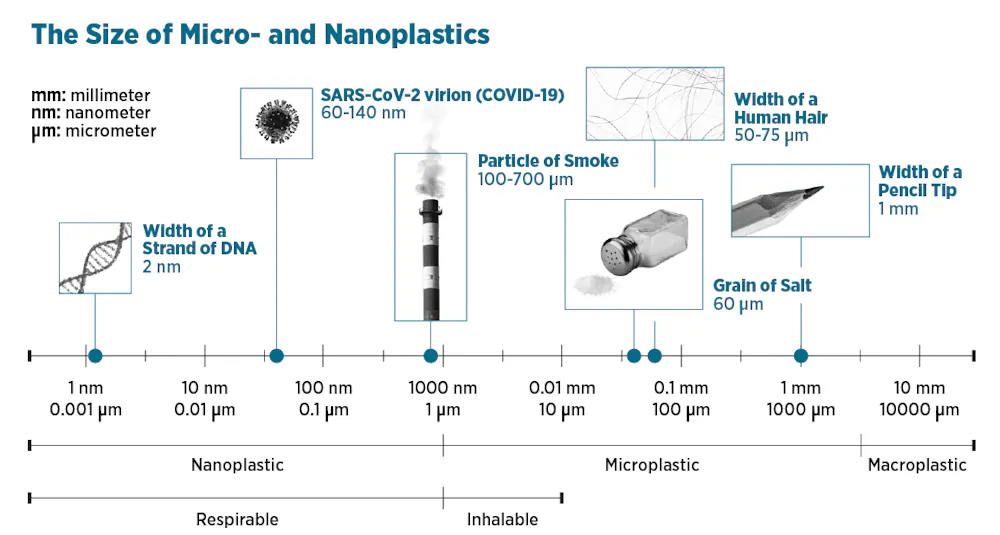
The fate of nanoplastics in the environment is an ongoing research topic. Scientists don’t know yet whether nanoplastics further degrade in various environments into smaller particles, or into polymers, which are their basic building blocks – large molecules made of many small molecules strung together.
Finding nanoplastics is challenging because they are so tiny and have diverse chemical compositions and structures. Researchers are refining different approaches for detecting nanoplastics, using techniques including Raman spectroscopy, chromatography and mass spectrometry. These methods can see the shapes and analyze the properties of nanoplastic particles.
In a 2024 study, researchers from Columbia University presented a new technology that was able to see and count nanoplastics in bottled water with high sensitivity and specificity. Unlike previous studies that could detect only a limited amount of nanoplastic particles, this study found that each liter of bottled water that was analyzed contained more than 100,000 plastic particles, most of which were nanoplastics.

More studies need to be done before scientists can conclude whether all bottled water contains nanoplastics. But this new technique opens the door for further research.
The toxicity of nanoplastics is another field of ongoing research. Some studies have suggested that these particles could pose significant risks to ecosystems and human health. One recent study suggested that they may be a risk factor for heart disease.
Another concern is that chemical pollutants, heavy metals and pathogens may stick to nanoplastics and become concentrated in the environment. This process could potentially expose living organisms to high concentrations of these harmful substances.
Nanoplastics clearly are a part of modern environments, but scientists need more research and information to understand what kinds of threats they could pose. As toxicologists often say, “The dose makes the poison.” In other words, actual exposure matters a lot. It is difficult to assess toxicity without knowing actual concentrations.
It is well known that larger plastic debris can fragment into nanoplastics, but there is much to learn about how these fragments degrade further. Researchers are working to detect and understand nanoplastics across many environments so that they can develop effective strategies to manage and mitigate these materials’ effects on people and the planet.
This article is republished from The Conversation under a Creative Commons license. Read the original article here.

COP26 has officially wrapped. A lot happened in two weeks, some step forwards and some steps back. Our team decided to recap highlights what really stood out to us.
The 26th annual COP concluded earlier this month and we wanted to highlight some of our takeaways from this historical conference.
Why was COP26 so important?
We are at a critical time in the fight against climate change. With temperatures currently sitting at 1.1℃ warmer than pre-industrial levels, it was undeniably important that world leaders came together to find ways to keep 1.5℃ alive through negotiations, commitments and pledges. Science proves that if our world warms past 1.5℃, there will be catastrophic and irreversible events. COP26 was also the first ratchet marker for nations who all agreed at COP21 (Paris) to re-evaluate their efforts every five years.
What were the results of COP26?
People have praised and criticized the outcomes of COP26 - however, one major result was the Glasgow Climate Pact. Similar to the Paris Accord, the Glasgow Climate Pact is an agreement based on two weeks of intense negotiations between 197 nations and organizations. The agreement includes the commitment to phase down (more on that below) the use of unabated coal, the consensus to re-visit climate action plans at COP27 with more aggressive targets, larger financial commitments from developed countries, and many other pledges from world leaders.
Although COP26 was the most aggressive form of COP talks since their inception, Climate Action Tracker shows that even if all COP26 commitments were executed the world is still on track to warm by 2.1℃.
Below we've outlined five takeaways that stood out to our team from the conference.
Coal is the single largest contributor to global warming. According to the End Coal Organization, burning coal is responsible for 46% of carbon dioxide emissions worldwide and accounts for 72% of total greenhouse gas (GHG) emissions from the electricity sector.
COP26 was the first time coal was named in an official COP declaration, it was the first time countries listed a fossil fuel as a major contributor to global warming and signifies that science took the forefront of discussions at COP26. This was a huge step in the right direction but more action needs to be taken.
At the end of COP26, there was a last-minute phrase change that switched "phasing OUT" coal with "phasing DOWN". Both India and China opposed the original wording.
The consensus is the world needs to transition to a clean and renewable energy economy but there need to be market and investment incentives to do so.
Commitments made at COP26:
There are many reasons why we need to prioritize halting deforestation. First, releasing CO₂ has the same effect on global warming no matter it comes from, whether it's from extracting fossil fuels or cutting down forests. Second, forests absorb and store CO₂! PNAS estimates that forests absorb up to 20% of emissions from the atmosphere each year.
Commitments made at COP26:
Simply put, climate adaptation means adapting our lives, behaviours and systems to protect our families, economies and our planet from the effects of climate change.
Climate adaptation can be pricey, especially for developing countries, so it's become essential that climate change funds work to reduce global warming and help ready individuals, businesses and countries for the life-threatening impacts of climate change (i.e. drought, wildfires, flooding, rising sea levels, etc.).
Although there were significant pledges made at COP26, one major concern is that there still isn't a program for hard-hit countries to receive financial aid for climate change losses and damages that occur as a result of actions, or non-actions, by major polluters countries like the USA and China.
Commitments made at COP26:
Climate change comes with a big price tag. One of the top goals for COP26 was how to mobilize finances from developed countries to countries that desperately need funds as they transition to a clean economy and prepare for the impacts of global warming (adaptation).
At COP15, developed countries pledged to mobilize USD $100 billion a year for developing countries by 2020, but this goal has not been met. In 2019, only around USD $80 million was sent to developing countries, up from USD $78 billion in 2018.
Commitments made at COP26:
COP26 was the first ratchet for nations post-COP21 that required updated climate plans from countries every five years, as outlined in the Paris Agreement. However, at COP26 world leaders agreed to launch an ANNUAL checkpoint process moving forward, rather than every five years. This signals a global understanding of the urgency to keep each other accountable and the need to revisit and increase efforts yearly if needed. This annual process will include detailed reporting, which will be peer-reviewed, and the requirement to increase NDCs (pledges to reduce greenhouse gas emissions and adapt to climate change) if they are too weak.
A new international board was also instated. The International Sustainability Standard Board will develop a comprehensive global baseline for sustainability reporting so everyone is on the same page.
World leaders also agreed to adopt the Enhanced Transparency Framework under the Paris Agreement that will see ALL countries reporting their national emissions and their progress towards achieving their NDCs every two years after 2024.
So many pledges made, so many 'agreements' signed, but what now? While COP26 had an urgency to it and the general consensus is we are headed in the right direction, the gap to make substantial change is quickly deteriorating. The time to take concrete action is now!
We understand the urgent need to change the way items around the world are extracted, produced and discarded in order to keep 1.5℃ alive. That's why our products and solutions are designed to have an immediate impact while supporting goals for long-term change. At Smart Plastic, we aren't promising solutions for 5, 10 or 20 years down the line. We're delivering tangible, sustainable products NOW.
References
https://ukcop26.org/wp-content/uploads/2021/11/COP26-Negotiations-Explained.pdf
https://endcoal.org/climate-change/
https://www.pnas.org/content/116/10/4382
https://www.un.org/en/climatechange/climate-adaptation
https://www.bbc.com/news/science-environment-59088498
https://www.unep.org/news-and-stories/story/what-does-cop26-mean-adaptation
https://www.nature.com/articles/d41586-021-02846-3
https://page.theconversation.com/cop26-glasgow-2021-climate-change-summit/
https://theconversation.com/five-things-you-need-to-know-about-the-glasgow-climate-pact-171799

Nearly half of of women's clothes for sale on some of the leading online websites are made entirely from new plastics, according to a study.
The BBC writes on June 11, 2021, Half of fast fashion made of new plastics, finds report.
Research completed by Royal Society for the Arts (RSA) found on average 49% of clothing made by Boohoo, Prettylittlething, Missguided and Asos were made of polyester, acrylic, nylon and elastane, with only 3% of those clothes containing recycled plastics.

Researchers have created a plant-based, sustainable, scalable material that could replace single-use plastics in many consumer products.
Genetic Engineering & Biotechnology News writes: Plant-Based, Sustainable, Scalable “Spider Silk” Provides Plastic Alternative.
The strongest material on the planet, spider silk, is the inspiration behind a new plant-based plastic alternative, removing the challenges that come with the micro and nano structures of traditional plant-based plastic. This new, energy efficient method mimics spider silk on a molecular level and will result in a plastic-like free-standing film that can be composted at home.

The companies that make, sell or rent pallets are working harder than ever to help customers achieve their supply chain sustainability goals.
Bridget McCrea writes for Modern Materials Handling in Supporting the world’s sustainability goals, one pallet at a time:
Pallets are often shared among companies, given a “second life” as retail store fixtures, and often pilfered, only to be yet again reused by the thieves that lifted them. Pallets are also active participants in the circular economy, a system aimed at eliminating waste and continually reusing resources.
End consumers are demanding more transparency when it comes to sustainability measures taken by large-scale organizations. To keep up with this demand and to support sustainable change in supply chains, companies like ORBIS, Litco International and PECO Pallets are implementing circular economy tactics when it comes to creating and recycling pallets.

Dave Ford, Executive Director of Ocean Plastics Leadership Network, writes:
Solving the plastic crisis is urgent. An estimated 11 million metric tons of plastic enter our oceans each year. That’s a garbage truck and a half of plastic every minute of every day. If we delay dramatic action by just five years, an additional 80 million metric tons of plastic will end up in the ocean by 2040 (250 Empire State Buildings worth of trash). Without action, by 2050 there will be more plastic in the ocean than fish, by weight.
Led by the Ocean Plastics Leadership Network in partnership with WWF and Greenpeace, this two day event garnered support for a global treaty that would be ambitious enough to match the scale and urgency of the plastic waste problem. Read the four key take aways from the virtual event over on GreenBiz.

After 72 years and billions of interlocking polymer toy bricks, the company finally has an eco-friendly alternative.
Jeremy White writing for Wired:
Each year, more than 380 million metric tons of plastic is produced worldwide. Lego is responsible for 100,000 metric tons of it. This contribution to the annual total is, of course, the result of making its classic children’s toy. Lego’s impact may initially appear to be a sliver of that plastic output, but it still counts. Why? That 100,000 metric tons of polymer was last year turned into 110 billion bricks.
Back in 2015, kids' toys conglomerate Lego announced it would be investing a large sum into a Sustainable Materials Center. Six years later and after testing over 250 PET materials, Lego has confirmed a suitable PET plastic alternative produced from discarded bottles. This discovery, made by a team of 150, is the first brick made from a recycled material that meets most of Lego’s requirements for its standard ABS bricks.