
Modern landfills are engineered to contain waste, not transform it, which is why what happens to plastic underground is decided at the formulation stage.
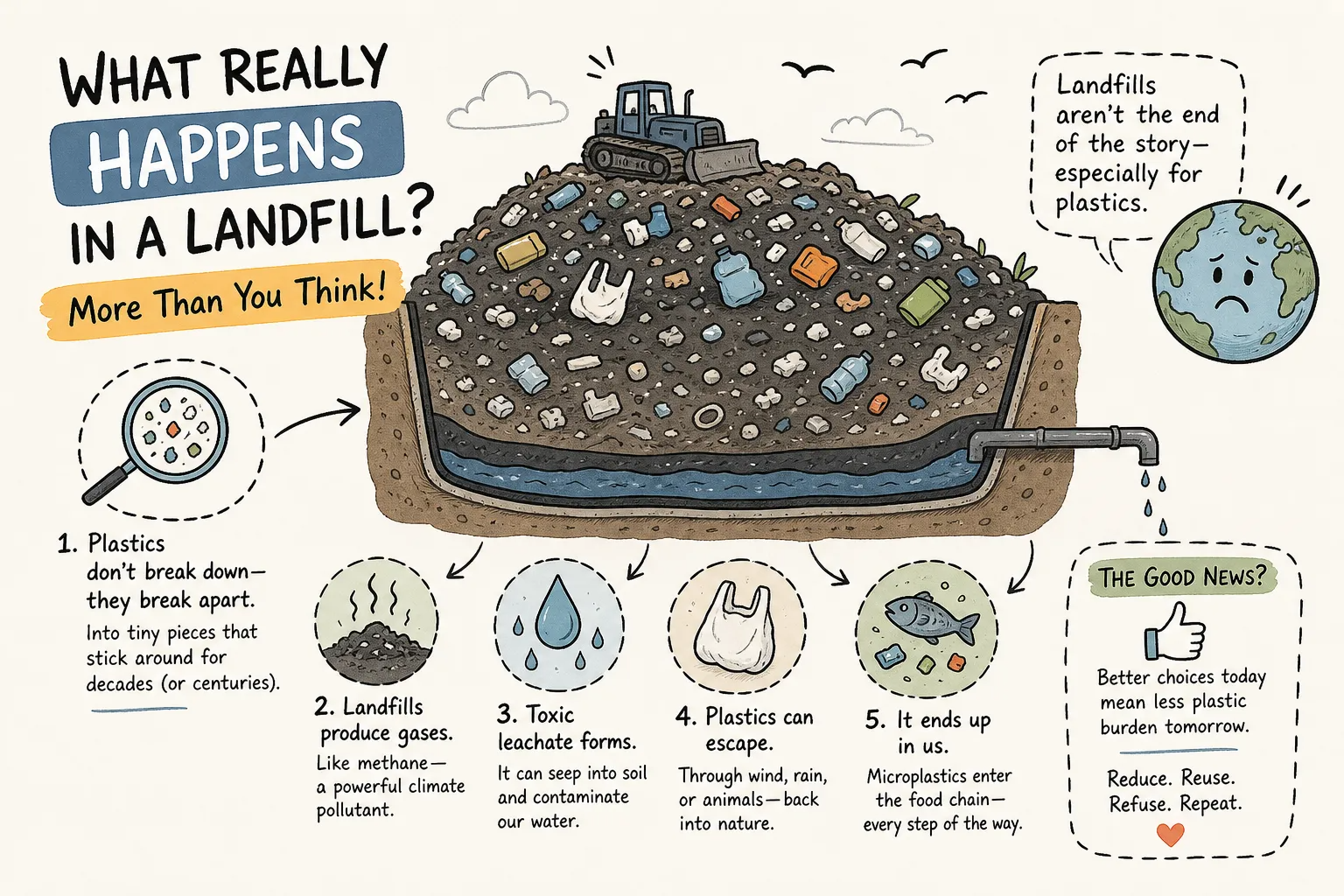
Understanding how landfills work starts with recognizing that modern municipal solid waste landfills (MSWLFs) are precision-engineered containment systems, not open pits. They use layered liners, leachate collection pipes, gas extraction wells, and decades of post-closure monitoring to manage the slow chemical transformation of everything buried inside them. But understanding how that engineering works reveals something the system cannot solve on its own: what happens to individual plastic particles inside the waste mass is entirely a materials problem, one that begins at the formulation stage, not at the landfill gate.
The seven facts below move through landfill operations in sequence, from the moment a truck arrives to the question converters and brand owners ask us most: does your material choice today determine an environmental outcome decades from now? According to the EPA's most recent national waste data, roughly 50% of U.S. municipal solid waste ends up in landfills. That figure alone explains why the answer matters.
Disposal at a modern MSWLF begins at the scalehouse. The loaded truck crosses a certified weighbridge, its gross weight is recorded, and operators log the hauler, waste type, vehicle, and time. From there, an attendant directs the truck along internal roads to the permitted disposal area, called the working face. Operators keep that active area intentionally small to control litter, odors, and pests.
After the truck tips its load, personnel may inspect the exposed waste to identify prohibited or hazardous materials. A dozer then spreads the waste into controlled layers, typically about two feet thick, and a heavy compactor makes repeated passes to crush and consolidate the material. The empty truck returns to the scalehouse for an outbound tare weigh; the net weight difference is used for billing and regulatory reporting. At the end of the day, the compacted working face is covered with soil, foam, or approved tarps to limit odors, vectors, and windblown litter until operations resume.
The working face is the visible part of the operation. Beneath it, a modern sanitary landfill cell is a carefully sequenced stack of barriers and drainage systems. Starting from the prepared subgrade and moving upward: a secondary composite liner (typically an HDPE geomembrane over compacted clay), a leak-detection drainage layer, a primary composite liner, a leachate drainage layer with perforated collection pipes, and then protective soil before the waste mass itself.
That double-liner design functions as a redundant containment system. The primary liner contains leachate; the secondary layer captures anything that bypasses it. Both feed toward sumps where pumps remove liquid for treatment, discharge, or shipment to a wastewater facility. Associated systems include vertical gas wells, stormwater drainage, groundwater-monitoring wells, and access roads. This is the physical foundation that every piece of waste, including the packaging your customers put on retail shelves, eventually rests on.
Buried organic waste moves through two stages. First, aerobic microbes consume trapped oxygen and produce mostly carbon dioxide. Once oxygen depletes, anaerobic microorganisms take over, generating landfill gas (LFG), roughly 50% methane and 50% carbon dioxide, plus trace compounds including hydrogen sulfide, siloxanes, and volatile organics. Operators capture this gas through vertical extraction wells drilled into the waste mass, often supplemented by horizontal perforated pipes in newer sections, with vacuum blowers drawing gas to a central header.
From the header, the options are flaring, direct energy use, or upgrading to renewable natural gas. Enclosed flares combust methane into carbon dioxide, preventing direct methane emissions; internal combustion engines or turbines burn the gas to generate electricity; and advanced treatment can strip CO₂ and other contaminants to produce pipeline-quality methane. Managing methane is not optional for large facilities, federal Clean Air Act regulations require gas collection and control systems at qualifying MSWLFs.
Compaction and low oxygen make a landfill environmentally safe; they are also exactly what prevents meaningful decomposition. Food scraps that would compost in weeks under aerobic conditions can persist for years underground. Paper remains readable for decades in dry cells. Steel cans take roughly 50–75 years, according to published decomposition data. Plastic bottles run to about 450 years. Polystyrene foam exceeds 500 years.
Gas generation often peaks around five to seven years after burial but can continue in smaller volumes for 50 years or more. Post-closure care at MSWLFs typically runs at least 30 years for this reason: the waste mass remains chemically and biologically active long after the last truck arrives. The low-oxygen containment environment that engineering creates is simultaneously a preservation chamber for everything that cannot biodegrade without it.
Polyethylene and polypropylene lack the chemical structure for microbial breakdown under landfill conditions. Without UV exposure and oxygen, photo-oxidative degradation stalls completely. What continues is mechanical fragmentation: compaction cracks and splinters plastic items into progressively smaller pieces over time. Those fragments don't bio-assimilate. They persist as polymer particles, eventually reaching microplastic scale, a risk that then compounds through the leachate pathway.
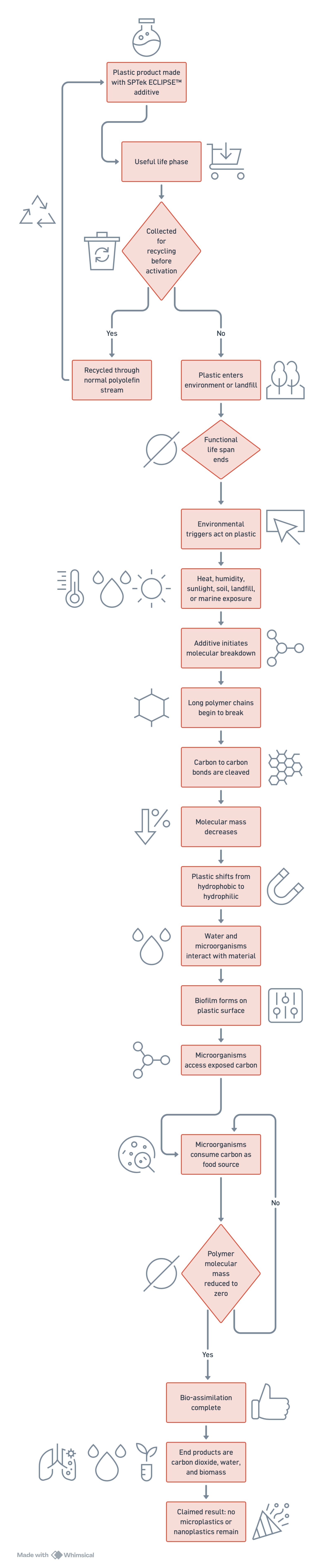
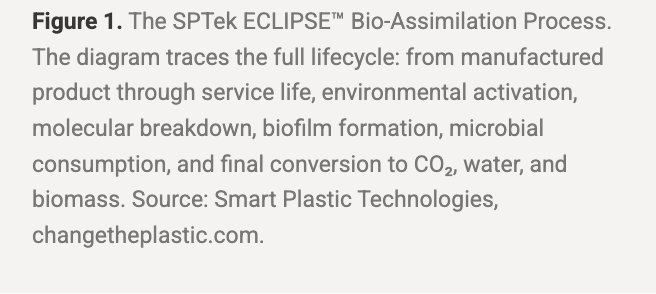
The distinction between degradation and bio-assimilation is not semantic. Degradation is physical breakdown into smaller pieces. Bio-assimilation is conversion of polymer carbon into CO₂, water, and biomass. Only the second outcome removes plastic from the persistent-material category. Research documents microplastics in landfill leachate and raises concern about their potential to reach groundwater where liner systems are compromised, though migration risk depends significantly on liner performance and site conditions. As for timing, studies and simulations indicate that fragmentation of conventional polyolefin films can begin within years under some conditions, while meaningful bio-assimilation for untreated polymers is effectively absent across any realistic timeframe.
For converters and brand owners facing regulatory pressure around plastic waste and microplastic pollution, that gap is the central issue. The material design decisions made before a product is sold determine what happens inside a landfill decades later. No liner system or gas collection network changes what happens to the polymer chain itself.
A bio-assimilation masterbatch additive is a formulation blended into polyethylene or polypropylene during standard converting processes. At end of life, in the anaerobic, biologically active environment of a landfill, it is designed to stimulate microbial colonization and assimilation of the polymer chain, converting plastic carbon into CO₂, water, and biomass rather than leaving persistent fragments.
Smart Plastic Technologies developed SPTek ECLIPSE®. Smart Plastic Technologies, a Certified B Corporation founded in 2016, based in Wheeling, Illinois, formulated ECLIPSE® as our patented bio-assimilation masterbatch technology for polyethylene flexible packaging and polypropylene rigid food-contact applications. It deploys as a drop-in additive, fully compatible with existing converting processes without retooling production lines.
ASTM D5526 measured anaerobic biodegradation under high-solids conditions, the laboratory analog of a landfill environment, tracking the percentage of carbon converted from a plastic sample into gaseous carbon under accelerated conditions. Note that ASTM D5526 was withdrawn in 2025; the data below was generated under that standard prior to its withdrawal, and we continue to evaluate which current protocols best represent real landfill conditions as the standards landscape evolves. Performance has also been evaluated using D6954-based protocols. Converters and brand owners should request full test documentation when assessing any bio-assimilation claim.
ECLIPSE®-treated film is fully recyclable before activation and FDA compliant for food-contact applications. That addresses the dual concern most procurement and sustainability teams raise: demonstrable recyclability while the product is in use, and a measurably different laboratory-measured end-of-life pathway when it inevitably reaches landfill disposal.
Not all additives that carry an environmental claim work the same way, and the differences are significant under anaerobic landfill conditions. Oxo-degradable additives are metal-based pro-oxidants that catalyze oxidation, chain scission, and fragmentation. They depend on oxygen, heat, and UV exposure to function. Landfills are dark and oxygen-limited. Under those conditions, the oxidation pathway is strongly suppressed, and what occurs instead is slower, uncontrolled fragmentation that generates microplastics without achieving meaningful bio-assimilation. Regulatory bodies including the European Chemicals Agency (ECHA), in its 2019 restriction proposal on oxo-degradable plastics, identified this as a core risk: these additives can accelerate the rate at which conventional plastic becomes microplastic rather than reducing it.
When evaluating any bio-assimilation additive, the validation criteria matter as much as the claim. The additive must be tested under landfill-relevant conditions: anaerobic, high-solids, using recognized protocols, not open-air oxidation studies. It must not compromise recyclability before activation. And the supporting data should be reviewed carefully for whether testing was conducted by an independent laboratory or by the manufacturer.
We developed the Smart Standard™ as a proposed end-of-life labeling framework specifically for bio-assimilating polyolefin packaging. The framework defines bio-assimilation as a specific, testable outcome: microorganisms must actually take up and metabolize the material's carbon in a defined biological environment, within a defined timeframe. That distinguishes it from vague "biodegradable" language, which specifies neither environment nor duration, and from compostability standards, which describe a material-plus-system outcome under industrial composting conditions.
The Smart Standard™ gives converters and brand owners a defined compliance and communication structure, allowing them to make a credible, testable claim about their packaging's landfill end-of-life rather than a generic sustainability statement. As U.S. states tighten regulations around plastic waste labeling and biodegradability claims, that level of specificity becomes a competitive and legal asset, not just a marketing choice.
ECLIPSE® is designed so that products can enter the standard recycle stream before activation occurs, keeping them compatible with existing recycling infrastructure. This aligns with circular economy principles: recycle first, and when a product inevitably reaches landfill disposal, the bio-assimilation mechanism engages rather than leaving fragmentation as the only outcome. Laboratory results show a measurably different carbon-conversion pathway compared with untreated controls; real-world validation under field conditions continues to develop alongside the broader standards landscape.
For sustainability officers and procurement teams managing ESG reporting requirements, that compatibility matters. A product that is recyclable before activation and engineered for a laboratory-demonstrated different landfill outcome addresses the full packaging lifecycle, not just one stage of it.
The engineering inside a modern MSWLF is sophisticated. Double liners, leachate collection, gas extraction, and decades of post-closure monitoring all exist because the engineers who design these systems understand what happens to complex waste over long timeframes. What that engineering cannot do is change the chemistry of an individual plastic particle inside the waste mass. Liners don't bio-assimilate polyethylene. Gas wells don't convert polypropylene fragments into biomass.
That is a material science problem, and it has to be addressed upstream, at the formulation and converting stage. Bio-assimilation additives like SPTek ECLIPSE® address it at the source, with laboratory data generated under ASTM D5526 prior to its 2025 withdrawal, deployed through a drop-in process that works within existing production infrastructure. The seven facts above trace a straight line from the moment a truck arrives at the scalehouse to the polymer-level outcome decades later. If you want to understand how landfills work and how ECLIPSE® fits your converting process, that line is the right place to start, and our team is ready to walk through it with you.
Yes, ECLIPSE®-treated film is fully recyclable before activation. This means products can enter the standard recycle stream prior to landfill disposal, keeping compatibility with existing recycling infrastructure and supporting a recycle-first approach.
Yes, ECLIPSE® is FDA compliant for food-contact applications. That compliance supports its use in polyethylene flexible packaging and polypropylene rigid food-contact uses while maintaining recyclability before activation.
You should review the full test documentation and consider results generated under ASTM D5526 prior to its 2025 withdrawal alongside D6954-based protocols. Requesting independent laboratory validation and selecting protocols that represent anaerobic, high-solids landfill conditions are important for assessing any bio-assimilation claim.
Microplastics in landfill leachate raise concern about potential groundwater reach where liner systems are compromised. The migration risk depends significantly on liner performance and site conditions, so containment integrity is a key factor in whether fragments move beyond the landfill system.

Understanding how landfills work starts with recognizing that modern municipal solid waste landfills (MSWLFs) are precision-engineered containment systems, not open pits. They use layered liners, leachate collection pipes, gas extraction wells, and decades of post-closure monitoring to manage the slow chemical transformation of everything buried inside them. But understanding how that engineering works reveals something the system cannot solve on its own: what happens to individual plastic particles inside the waste mass is entirely a materials problem, one that begins at the formulation stage, not at the landfill gate.
The seven facts below move through landfill operations in sequence, from the moment a truck arrives to the question converters and brand owners ask us most: does your material choice today determine an environmental outcome decades from now? According to the EPA's most recent national waste data, roughly 50% of U.S. municipal solid waste ends up in landfills. That figure alone explains why the answer matters.
Disposal at a modern MSWLF begins at the scalehouse. The loaded truck crosses a certified weighbridge, its gross weight is recorded, and operators log the hauler, waste type, vehicle, and time. From there, an attendant directs the truck along internal roads to the permitted disposal area, called the working face. Operators keep that active area intentionally small to control litter, odors, and pests.
After the truck tips its load, personnel may inspect the exposed waste to identify prohibited or hazardous materials. A dozer then spreads the waste into controlled layers, typically about two feet thick, and a heavy compactor makes repeated passes to crush and consolidate the material. The empty truck returns to the scalehouse for an outbound tare weigh; the net weight difference is used for billing and regulatory reporting. At the end of the day, the compacted working face is covered with soil, foam, or approved tarps to limit odors, vectors, and windblown litter until operations resume.
The working face is the visible part of the operation. Beneath it, a modern sanitary landfill cell is a carefully sequenced stack of barriers and drainage systems. Starting from the prepared subgrade and moving upward: a secondary composite liner (typically an HDPE geomembrane over compacted clay), a leak-detection drainage layer, a primary composite liner, a leachate drainage layer with perforated collection pipes, and then protective soil before the waste mass itself.
That double-liner design functions as a redundant containment system. The primary liner contains leachate; the secondary layer captures anything that bypasses it. Both feed toward sumps where pumps remove liquid for treatment, discharge, or shipment to a wastewater facility. Associated systems include vertical gas wells, stormwater drainage, groundwater-monitoring wells, and access roads. This is the physical foundation that every piece of waste, including the packaging your customers put on retail shelves, eventually rests on.
Buried organic waste moves through two stages. First, aerobic microbes consume trapped oxygen and produce mostly carbon dioxide. Once oxygen depletes, anaerobic microorganisms take over, generating landfill gas (LFG), roughly 50% methane and 50% carbon dioxide, plus trace compounds including hydrogen sulfide, siloxanes, and volatile organics. Operators capture this gas through vertical extraction wells drilled into the waste mass, often supplemented by horizontal perforated pipes in newer sections, with vacuum blowers drawing gas to a central header.
From the header, the options are flaring, direct energy use, or upgrading to renewable natural gas. Enclosed flares combust methane into carbon dioxide, preventing direct methane emissions; internal combustion engines or turbines burn the gas to generate electricity; and advanced treatment can strip CO₂ and other contaminants to produce pipeline-quality methane. Managing methane is not optional for large facilities, federal Clean Air Act regulations require gas collection and control systems at qualifying MSWLFs.
Compaction and low oxygen make a landfill environmentally safe; they are also exactly what prevents meaningful decomposition. Food scraps that would compost in weeks under aerobic conditions can persist for years underground. Paper remains readable for decades in dry cells. Steel cans take roughly 50–75 years, according to published decomposition data. Plastic bottles run to about 450 years. Polystyrene foam exceeds 500 years.
Gas generation often peaks around five to seven years after burial but can continue in smaller volumes for 50 years or more. Post-closure care at MSWLFs typically runs at least 30 years for this reason: the waste mass remains chemically and biologically active long after the last truck arrives. The low-oxygen containment environment that engineering creates is simultaneously a preservation chamber for everything that cannot biodegrade without it.
Polyethylene and polypropylene lack the chemical structure for microbial breakdown under landfill conditions. Without UV exposure and oxygen, photo-oxidative degradation stalls completely. What continues is mechanical fragmentation: compaction cracks and splinters plastic items into progressively smaller pieces over time. Those fragments don't bio-assimilate. They persist as polymer particles, eventually reaching microplastic scale, a risk that then compounds through the leachate pathway.
The distinction between degradation and bio-assimilation is not semantic. Degradation is physical breakdown into smaller pieces. Bio-assimilation is conversion of polymer carbon into CO₂, water, and biomass. Only the second outcome removes plastic from the persistent-material category. Research documents microplastics in landfill leachate and raises concern about their potential to reach groundwater where liner systems are compromised, though migration risk depends significantly on liner performance and site conditions. As for timing, studies and simulations indicate that fragmentation of conventional polyolefin films can begin within years under some conditions, while meaningful bio-assimilation for untreated polymers is effectively absent across any realistic timeframe.
For converters and brand owners facing regulatory pressure around plastic waste and microplastic pollution, that gap is the central issue. The material design decisions made before a product is sold determine what happens inside a landfill decades later. No liner system or gas collection network changes what happens to the polymer chain itself.
A bio-assimilation masterbatch additive is a formulation blended into polyethylene or polypropylene during standard converting processes. At end of life, in the anaerobic, biologically active environment of a landfill, it is designed to stimulate microbial colonization and assimilation of the polymer chain, converting plastic carbon into CO₂, water, and biomass rather than leaving persistent fragments.
Smart Plastic Technologies developed SPTek ECLIPSE®. Smart Plastic Technologies, a Certified B Corporation founded in 2016, based in Wheeling, Illinois, formulated ECLIPSE® as our patented bio-assimilation masterbatch technology for polyethylene flexible packaging and polypropylene rigid food-contact applications. It deploys as a drop-in additive, fully compatible with existing converting processes without retooling production lines.
ASTM D5526 measured anaerobic biodegradation under high-solids conditions, the laboratory analog of a landfill environment, tracking the percentage of carbon converted from a plastic sample into gaseous carbon under accelerated conditions. Note that ASTM D5526 was withdrawn in 2025; the data below was generated under that standard prior to its withdrawal, and we continue to evaluate which current protocols best represent real landfill conditions as the standards landscape evolves. Performance has also been evaluated using D6954-based protocols. Converters and brand owners should request full test documentation when assessing any bio-assimilation claim.
ECLIPSE®-treated film is fully recyclable before activation and FDA compliant for food-contact applications. That addresses the dual concern most procurement and sustainability teams raise: demonstrable recyclability while the product is in use, and a measurably different laboratory-measured end-of-life pathway when it inevitably reaches landfill disposal.
Not all additives that carry an environmental claim work the same way, and the differences are significant under anaerobic landfill conditions. Oxo-degradable additives are metal-based pro-oxidants that catalyze oxidation, chain scission, and fragmentation. They depend on oxygen, heat, and UV exposure to function. Landfills are dark and oxygen-limited. Under those conditions, the oxidation pathway is strongly suppressed, and what occurs instead is slower, uncontrolled fragmentation that generates microplastics without achieving meaningful bio-assimilation. Regulatory bodies including the European Chemicals Agency (ECHA), in its 2019 restriction proposal on oxo-degradable plastics, identified this as a core risk: these additives can accelerate the rate at which conventional plastic becomes microplastic rather than reducing it.
When evaluating any bio-assimilation additive, the validation criteria matter as much as the claim. The additive must be tested under landfill-relevant conditions: anaerobic, high-solids, using recognized protocols, not open-air oxidation studies. It must not compromise recyclability before activation. And the supporting data should be reviewed carefully for whether testing was conducted by an independent laboratory or by the manufacturer.
We developed the Smart Standard™ as a proposed end-of-life labeling framework specifically for bio-assimilating polyolefin packaging. The framework defines bio-assimilation as a specific, testable outcome: microorganisms must actually take up and metabolize the material's carbon in a defined biological environment, within a defined timeframe. That distinguishes it from vague "biodegradable" language, which specifies neither environment nor duration, and from compostability standards, which describe a material-plus-system outcome under industrial composting conditions.
The Smart Standard™ gives converters and brand owners a defined compliance and communication structure, allowing them to make a credible, testable claim about their packaging's landfill end-of-life rather than a generic sustainability statement. As U.S. states tighten regulations around plastic waste labeling and biodegradability claims, that level of specificity becomes a competitive and legal asset, not just a marketing choice.
ECLIPSE® is designed so that products can enter the standard recycle stream before activation occurs, keeping them compatible with existing recycling infrastructure. This aligns with circular economy principles: recycle first, and when a product inevitably reaches landfill disposal, the bio-assimilation mechanism engages rather than leaving fragmentation as the only outcome. Laboratory results show a measurably different carbon-conversion pathway compared with untreated controls; real-world validation under field conditions continues to develop alongside the broader standards landscape.
For sustainability officers and procurement teams managing ESG reporting requirements, that compatibility matters. A product that is recyclable before activation and engineered for a laboratory-demonstrated different landfill outcome addresses the full packaging lifecycle, not just one stage of it.
The engineering inside a modern MSWLF is sophisticated. Double liners, leachate collection, gas extraction, and decades of post-closure monitoring all exist because the engineers who design these systems understand what happens to complex waste over long timeframes. What that engineering cannot do is change the chemistry of an individual plastic particle inside the waste mass. Liners don't bio-assimilate polyethylene. Gas wells don't convert polypropylene fragments into biomass.
That is a material science problem, and it has to be addressed upstream, at the formulation and converting stage. Bio-assimilation additives like SPTek ECLIPSE® address it at the source, with laboratory data generated under ASTM D5526 prior to its 2025 withdrawal, deployed through a drop-in process that works within existing production infrastructure. The seven facts above trace a straight line from the moment a truck arrives at the scalehouse to the polymer-level outcome decades later. If you want to understand how landfills work and how ECLIPSE® fits your converting process, that line is the right place to start, and our team is ready to walk through it with you.
Yes, ECLIPSE®-treated film is fully recyclable before activation. This means products can enter the standard recycle stream prior to landfill disposal, keeping compatibility with existing recycling infrastructure and supporting a recycle-first approach.
Yes, ECLIPSE® is FDA compliant for food-contact applications. That compliance supports its use in polyethylene flexible packaging and polypropylene rigid food-contact uses while maintaining recyclability before activation.
You should review the full test documentation and consider results generated under ASTM D5526 prior to its 2025 withdrawal alongside D6954-based protocols. Requesting independent laboratory validation and selecting protocols that represent anaerobic, high-solids landfill conditions are important for assessing any bio-assimilation claim.
Microplastics in landfill leachate raise concern about potential groundwater reach where liner systems are compromised. The migration risk depends significantly on liner performance and site conditions, so containment integrity is a key factor in whether fragments move beyond the landfill system.
U.S. Patent No. 12,668,672 includes issued claims directed to specific SPTek ECLIPSE® master batch formulations, moving Smart Plastic from patent-pending to patent-protected.

Smart Plastic and its SPTek ECLIPSE® bio-assimilation technology took the top honor at Trellis Impact 26 in San Francisco.


