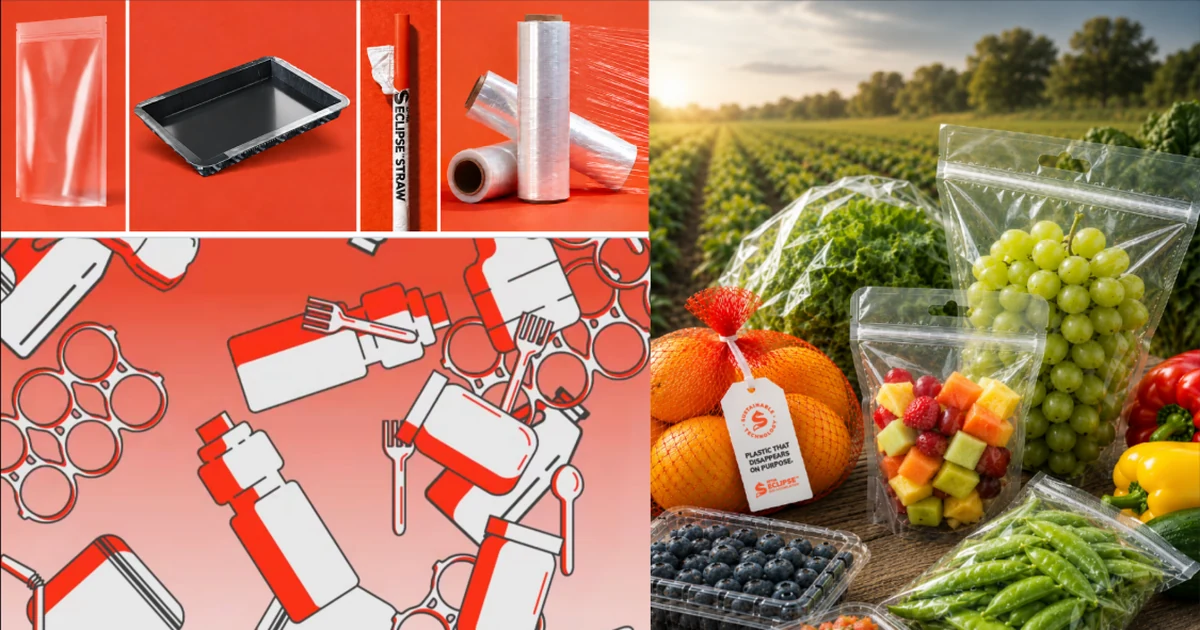
A look at SPTek ECLIPSE®, a 1% polyolefin additive built to give plastic that won't be recycled a built-in exit plan.
Roughly 350 million tons of plastic reach the end of their life every year, and about a quarter of that is mismanaged — not recycled, not incinerated, not safely landfilled, just loose in the environment. A big share of it is polyolefins. Polyethylene and polypropylene, the workhorses behind stretch film, pouches, straws, and shopping bags, together make up something like 45% of everything the world produces as plastic. Most of it is exactly the kind of flexible packaging that recycling infrastructure struggles to touch.
I recently spoke with Yaman Peksenar, director of science and technology at Smart Plastic Technologies, about an additive called SPTek ECLIPSE® that's built for that gap — the plastic that, realistically, will not be recycled.
ECLIPSE gets mixed into polyolefin resin at about 1%, the same way a manufacturer would add colorant, or a masterbatch. Once blended in, it's invisible: no change to color, clarity, or how the plastic behaves in use. Inside that 1%, though, sits a catalyst paired with stabilizers whose entire job is to hold it in check.
That's the clever part. The stabilizers get consumed first, and only once they're used up does the catalyst go to work — so a manufacturer can dial in a product's functional shelf life, from about a year out to seven-plus. The formulation is built to preserve the product through its working life before the next stage begins; something like a stretch-wrap film gets tuned for a shorter run, a piece of rigid tableware for a longer one, with the exact timing set by the product and its conditions of use. Heat and UV exposure at end of life finally wake the catalyst up, and moisture afterward gets biofilm growing on the surface.
From there, it's an oxidation reaction. The catalyst cuts the plastic's long carbon backbone into shorter and shorter pieces — company data describes the molecular weight stepping down from around 200,000 to roughly 5,000 and below, the point at which microbes stop treating the material as inert and start treating it as a food source. Continue that far enough and the plastic's carbon converts, at the molecular level, into CO2, water, and biomass — how far and how fast depends on the conditions it's breaking down in.
The claims aren't just a company brochure. Smart Plastic has run its ECLIPSE-treated film through a stack of third-party labs:
Smart Plastic secured a U.S. patent in June 2026 on specific ECLIPSE masterbatch formulations. “An issued patent is an important milestone for Smart Plastic and for SPTek Eclipse,” Yaman told PlasticsToday when it came through, pointing to the years of USPTO examination behind it. Colleague Robin Misir, VP of operations, described the skepticism Smart Plastic runs into plainly: manufacturers considering the material tend to ask the same question first — is this real, or just another pending application? Today, Smart Plastic uses ECLIPSE in both flexible HDPE/LLDPE packaging and rigid, food-contact polypropylene.
Here's the part I found most reassuring: ECLIPSE isn't sold as competition for recycling. The pitch is closer to this — if you're recycling, great, keep doing it; if your product ends up in a landfill anyway, this is what you need. Before end-of-life triggers kick in, ECLIPSE-treated resin runs through standard mechanical recycling equipment just fine, and recyclers add their own stabilizers that make accidental activation even less likely. Post-consumer recycled content can be blended in alongside it, too, without giving up EPR credit.
The friction shows up elsewhere. Recycling guidelines currently prohibit additives like this one outright, and shifting that position means working through eco-modularity credits under emerging EPR legislation — a slow, expensive lobbying track. Against bio-based polyethylene (non-degradable, roughly triple the cost) or compostable resins (a 20%+ premium), ECLIPSE is a drop-in replacement at under a 5% cost bump with no production-line changes. ECLIPSE itself is already co-branded into a commercial stretch-wrap line, Sigma Vanish, built around the tagline: if you can't recycle it, make it vanish.
The economics favor adoption. The habit doesn't, yet — reformulating a cost-optimized supply chain is a hard sell until legislation or litigation makes the status quo more expensive than the change.
If your product's most likely ending is a landfill rather than a recycling bin, wouldn't you want the plastic itself carrying an exit plan?
This article originally appeared in Dr. John Skabardonis’s newsletter Tech Nuggets, which you may subscribe to here. John is the founder of Optimist Consulting and is a PhD chemist, keynote speaker, and Distinguished Toastmaster (DTM). He has spent decades making complex, technical ideas impossible to ignore. As a subject matter expert at the intersection of science, innovation, and sustainability, he explores where science and environmental responsibility is at the core of all activity every single day.