With new technology and developments around every corner, things move fast at Smart Plastic HQ. Keep up with everything right here.

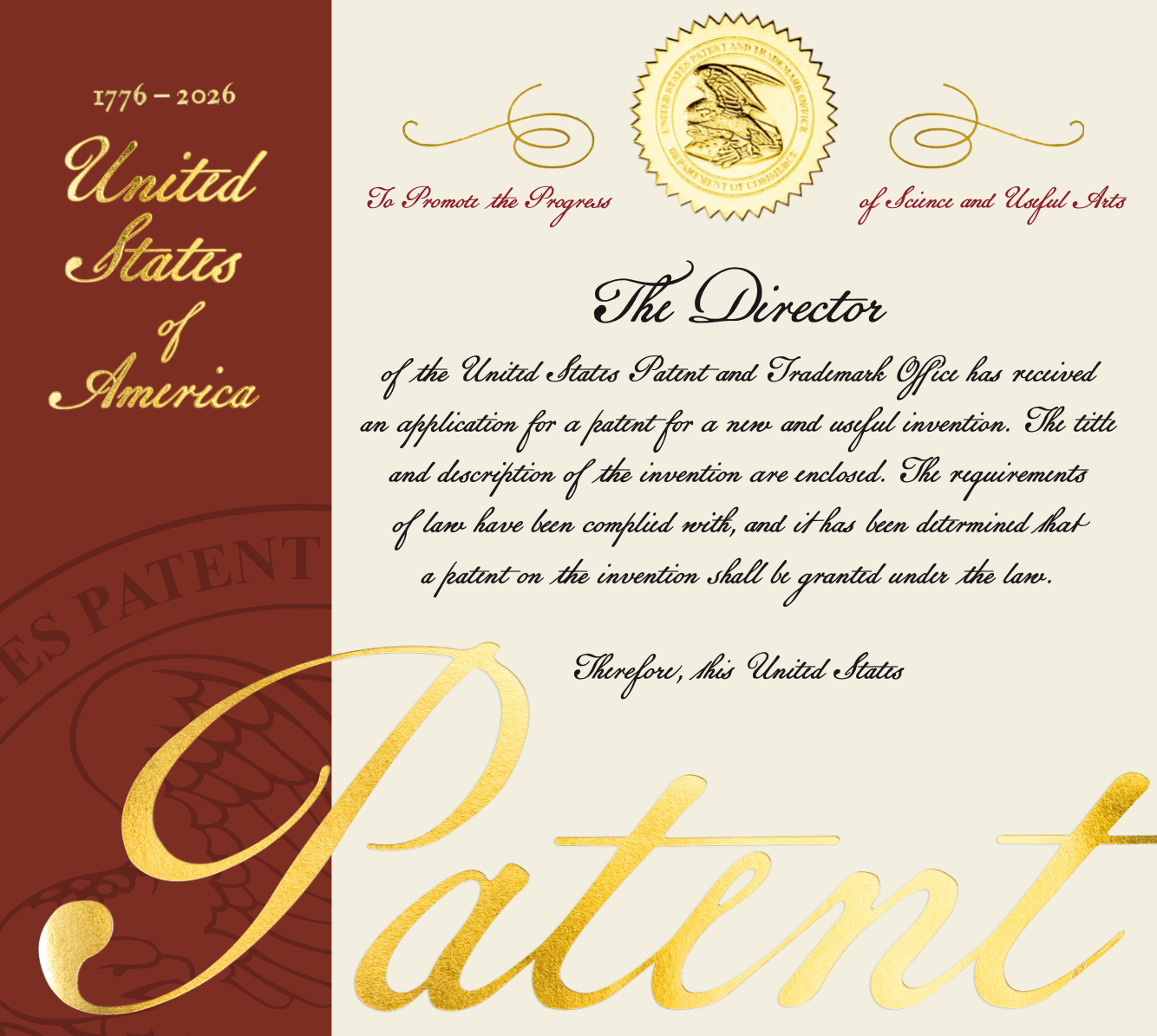
U.S. Patent No. 12,668,672 includes issued claims directed to specific SPTek ECLIPSE® master batch formulations, moving Smart Plastic from patent-pending to patent-protected.
CHICAGO, Ill. (July 14, 2026) — Smart Plastic Technologies, LLC today announced that the United States Patent and Trademark Office has issued U.S. Patent No. 12,668,672 B2, “Bio-Assimilation Master Batch Composition, Processes for Producing Polymeric Bio-Assimilating Material Therefrom, and Products Produced Therefrom.” The issued claims are directed to specific SPTek ECLIPSE® master batch formulations for polyolefin applications, including formulations designed for approximately 18-month and 24-month functional-life use cases. The patent marks an important transition from patent-pending to issued-patent status for Smart Plastic’s SPTek ECLIPSE® technology platform. The newly issued patent is part of a broader Smart Plastic patent portfolio strategy, which includes pending continuation and continuation-in-part applications directed to additional aspects of the SPTek ECLIPSE® technology platform.
For a plastics industry crowded with companies claiming similar end-of-life solutions, an issued U.S. patent provides a concrete, publicly reviewable milestone. The issued claims are directed to specific SPTek ECLIPSE® master batch formulations and were allowed after examination against cited prior art, including references relating to microorganism colonization of plastics and biodegradation testing. Smart Plastic separately supports its performance claims through technical testing, including ASTM D5526 and D6954-based work.
“An issued patent is an important milestone for Smart Plastic and for SPTek ECLIPSE®,” said Yaman Peksenar, Director of Science & Technology at Smart Plastic Technologies. “After a multi-year USPTO examination, we now have issued claims to specific master batch chemistries that are central to our SPTek ECLIPSE® platform. Combined with our technical testing program, which is third-party validated, this gives manufacturers and brand owners a clearer basis to evaluate the technology.”
SmartPlastic’s SPTek ECLIPSE® transforms conventional polyethylene and polypropylene — resin Types 2, 4, and 5 — into materials that, as supported by Smart Plastic's functional testing, promote bio-assimilation at the end of their intended functional life, supporting breakdown into CO2, water, and biomass rather than fragmenting into microplastics. The newly issued patent’s claims cover master batch formulations tuned to specific functional lifespans — from a formulation built on HDPE/LLDPE blends designed for about 18 months of use in flexible packaging, to a polypropylene formulation designed for about 24 months of use in rigid, food-contact applications such as consumer tableware. The issued claims recite a 1% inclusion rate for the approximately 18-month formulation and a 1.5% inclusion rate for the approximately 24-month polypropylene formulation, while Smart Plastic separately evaluates recyclability and food-contact suitability for applicable products.
“Our manufacturing partners ask us the same question in every first meeting: is this real or is it another pending application dressed up as a solution?” said Robin Misir, Vice President of Operations at Smart Plastic Technologies. “Now the answer includes an issued U.S. patent number they can review themselves, alongside Smart Plastic’s technical data. That changes the conversation with converters and brand owners who’ve been sitting on the sidelines waiting for exactly this kind of issued-patent milestone and technical documentation before they commit a production line to SPTek ECLIPSE®.”
SmartPlastic is pairing the announcement with a renewed push for the Smart Standard™, the company’s proposed end-of-life disposal and labeling framework for bio-assimilating plastics. The company argues that conventional recycling captures only about 9% of plastic waste and that industrial composting requires infrastructure most communities do not have, leaving polyolefin packaging with no realistic end-of-life path today. Smart Plastic is inviting brand owners, converters, and regulators to review the Smart Standard alongside the newly issued patent documentation at changetheplastic.com.
SmartPlastic Technologies LLC, a certified B Corporation, is based in Wheeling, Illinois. Founded in 2016, the company is revolutionizing the potential of plastic to improve the environment for future generations. Its flagship bio-assimilation technology, SPTek ECLIPSE®, is supported by U.S. Patent No. 12,668,672 and is designed to help selected polyethylene and polypropylene applications undergo bio-assimilation after the article’s intended useful life, with the goal of reducing persistent plastic fragments. Smart Plastic’s mission is to prevent persistent microplastic pollution in everyday packaging solutions. This represents a key and critical aspect of the company’s commitment to plastic lifecycle management. Smart Plastic works with manufacturing partners to evaluate product-specific performance, recyclability, and applicable regulatory requirements. All Smart Plastic technologies are designed to alter the very nature of plastic for the benefit of both people and the planet. Proudly made in the United States, all Smart Plastic products are 100% recyclable pre-activation, FDA compliant, and purposely designed for the circular and regenerative economies. Learn more at www.changetheplastic.com

Smart Plastic and its SPTek ECLIPSE® bio-assimilation technology took the top honor at Trellis Impact 26 in San Francisco.
CHICAGO, Ill. — June 26, 2026 — Smart Plastic Technologies, LLC has been named Trellis Group’s 2026 Climate Tech Startup of the Year, an honor awarded following a live pitch competition on June 25 at Trellis Impact 26 in San Francisco. The company, maker of SPTek ECLIPSE® bio-assimilation technology, was selected from a field of finalists whose innovations spanned battery materials, industrial waste-to-chemicals, critical-mineral recovery, and advanced coatings.
Smart Plastic earned the top vote from the audience for an additive technology aimed at the roughly 91 percent of plastic that is never recycled. Chief Sustainability Officer Sumathi Pakki delivered the company’s winning remarks.
“Plastic was not designed with its end in mind. We changed that.”
— Sumathi Pakki, Chief Sustainability Officer
Smart Plastic was earlier named to Trellis’s “15 Climate Tech Startups to Watch in 2026” in the material innovation category, a list reserved for seed to Series A companies with real traction and customers already signed up. The recognition places Smart Plastic among the climate technologies that corporate buyers, operators, and investors are prioritizing for near-term deployment.
SPTek ECLIPSE® is a drop-in additive used at approximately one percent inclusion, with no new equipment required. It is designed to preserve performance during use, then support bio-assimilation of the plastic to carbon dioxide, water, and biomass if the material is not recovered, as validated by independent laboratories.
“This recognition belongs to a team that has chosen to win on science and credibility rather than hype. It comes at a moment when brand owners need end-of-life solutions that are operationally realistic and ready to scale.” — Yaman Peksenar, Director of Science & Technology
Smart Plastic Technologies, based in Wheeling, Illinois, develops materials solutions designed to improve the end-of-life outcomes of everyday plastic. Its platform, including its patented SPTek ECLIPSE® bio-assimilation technology, is built to work with conventional polyolefins while supporting a more responsible pathway when plastic is not recovered. Smart Plastic Technologies is a Certified B Corporation. Learn more at changetheplastic.com.
View the presentation on our YouTube channel: https://youtu.be/gPt4zUasQyk
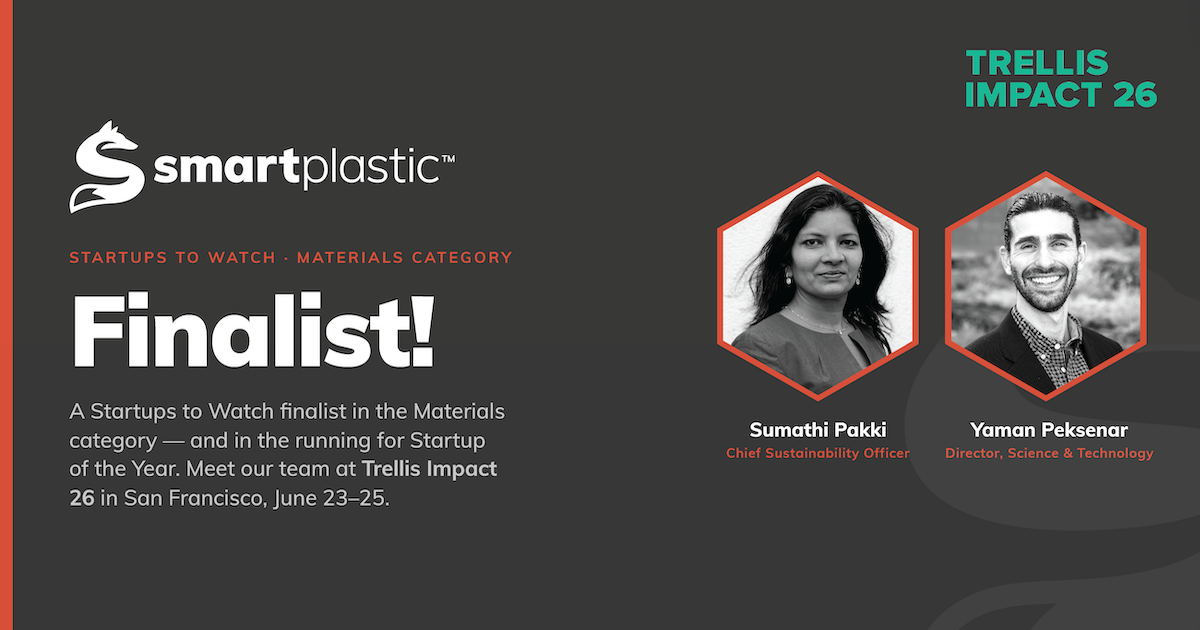
Our Chief Sustainability Officer Suma Pakki takes the Startup Day Mainstage in San Francisco this week, pitching ECLIPSE® as a Materials finalist for Trellis Group's Startup of the Year.
Five weeks ago, we asked you to vote. You did. Today we can say it plainly: Smart Plastic Technologies advanced out of the Materials field of Trellis’s Startups to Watch competition to the in-person finale, and we are in the running to be named Trellis Group’s Startup of the Year.
The deciding pitches happen live during the Startups to Watch Finale on the Startup Day Mainstage — Wednesday, June 24, 9:00–10:30 a.m. at the Moscone Center in San Francisco. Suma Pakki and Yaman Peksenar are carrying the SPTek ECLIPSE® story into the room, in front of thousands of the operators, buyers, and investors who actually move this industry, with leading climate investors as judges.
Trellis Impact is not a trade show with a recycling booth in the corner. It is the premier gathering for sustainable business, convening roughly 2,500 leaders, 300-plus speakers, and 100-plus sessions across the people who turn climate ideas into deployed solutions: Fortune 500 decision-makers, climate-tech founders, and the capital that funds them.
The program is organized around five tracks that, read together, describe the whole arc of the clean economy:
Smart Plastic lives at the intersection of the first and the last. “Close the Loop” is the entire premise of our company: a polyolefin should perform during its useful life, stay recyclable while it is needed, and then, if it escapes recovery, return to nature instead of fragmenting into permanent pollution. “Unlock Startup Innovation” is the bridge we are crossing right now, from validated science to deployed product.
Startups to Watch is a fast-pitch competition across three strategic categories: Data Center Solutions, Material Innovation, and Climate Adaptation. Trellis named the top finalists in each, ran virtual pitch webinars with community voting, and now brings the standouts to the in-person finale. One company walks away as Startup of the Year. Last year that title went to DexMat.
The finale field is a genuinely strong, cross-category group. Joining Smart Plastic on the Startup Day Mainstage are Skyven Technologies, Helix Earth, Airloom Energy, and Mojave Energy Systems — companies working on industrial heat, efficiency, and clean energy. We are the materials answer in that lineup: the one rethinking what plastic becomes after its useful life. Being measured against companies of that caliber, judged by investors from Engine Ventures, Prelude Ventures, Voyager Ventures, VoLo Earth, and At One Ventures, is exactly the kind of pressure a deployment-ready solution should welcome.
It matters that this recognition comes from Trellis specifically. Trellis sets its eligibility bar at Seed-to-Series-A companies that are incorporated, staffed, and have a product ready to test or deploy — traction over hype. That is the conversation we want to be in.
For a startup fighting an entrenched industry, visibility is leverage. The plastics value chain is slow to change, and some of the loudest voices in end-of-life standards have incentives to keep things as they are. A stage like Trellis Impact lets us make our case directly to the people who can adopt ECLIPSE® — brand owners, converters, and packaging buyers — without waiting for permission from the gatekeepers.
The recognition also arrives at a moment when capital is flowing to climate companies that can show results rather than slides. We are not pitching a concept. SPTek ECLIPSE® is a drop-in additive at roughly 1% inclusion that requires no retooling, is FDA-compliant for food contact (GRAS), and runs on existing extrusion lines. Independent testing validates bio-assimilation across marine, terrestrial, and anaerobic landfill conditions, with no microplastic residue left behind. And the model is already working in market: more than $1.1M in sales through Q1 2026 and a manufacturing partnership with Sigma Plastics.
That is the difference we will put in front of the judges. Most material solutions ask the world to rebuild its infrastructure first. SPTek ECLIPSE® asks for one percent.
Whatever the judges decide this week, the meaning is the same. Smart Plastic is being taken seriously, on the main stage of sustainable business, as a materials company with science behind it and product in the market. That is how a new standard takes hold: not by shouting louder than the incumbents, but by showing buyers and partners that a better end-of-life outcome is available today, at almost no added cost.
To everyone who voted, shared, and believed plastic should be engineered with its full lifecycle in mind: thank you. You helped get us here.
If you are at Trellis Impact 26, watch the Startups to Watch Finale on the Startup Day Mainstage Wednesday morning, and come find Suma and Yaman afterward. Let’s build a smarter standard together.
Smart Plastic Technologies develops materials solutions designed to improve plastic end-of-life outcomes. Its platform, including SPTek ECLIPSE®, is built to work with conventional polyolefins (PE and PP) while supporting a more responsible path when plastic is not recovered. Learn more at changetheplastic.com.
A plain-language guide to SPTek ECLIPSE® technology — changetheplastic.com
The Problem
More than 90% of plastic ever produced has never been recycled. It does not disappear. It simply accumulates in landfills, oceans, soils, and eventually inside living organisms. Conventional plastic can persist for hundreds of years without any meaningful change to its molecular structure.
The global plastics industry has long recognized this problem, and numerous technologies have been proposed as solutions. Two of the most commonly discussed are biodegradation and oxo-degradation. Both are widely marketed. Both fall critically short of solving the problem. Understanding why requires a clear-eyed look at what each process actually does at the molecular level, and what it leaves behind.
Technology One
The word "biodegradable" sounds reassuring. In everyday language, it implies that something will naturally break down and return harmlessly to the earth. For materials like food scraps, paper, or wood, this is essentially true. For conventional plastic, it is far more complicated.
Biodegradation is a process in which microorganisms, primarily bacteria and fungi, break down organic material into simpler compounds. When it works fully, the end products are carbon dioxide (CO₂), water, and biomass, leaving nothing harmful behind. The critical qualifier is when it works fully.
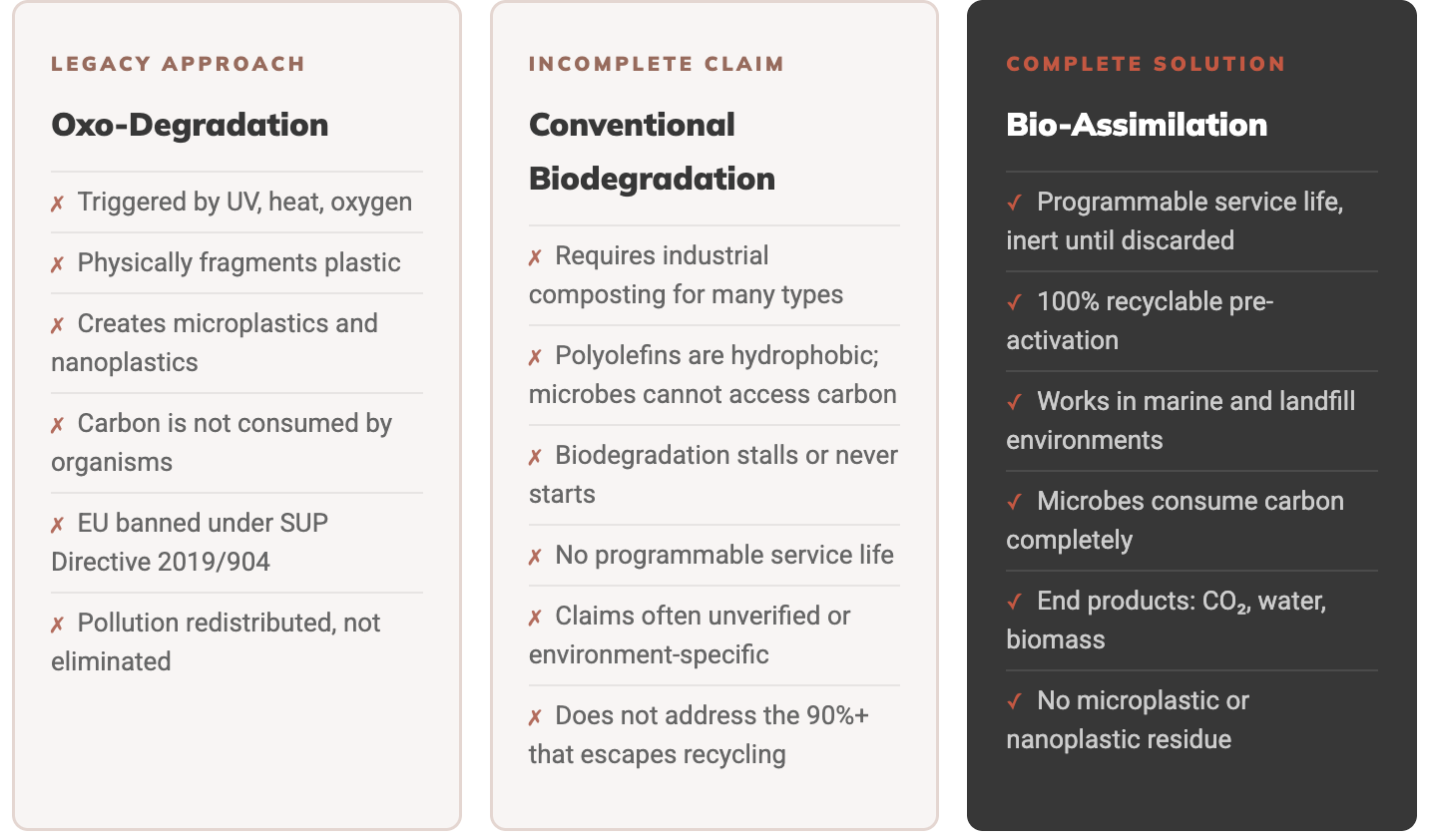
Conventional polyolefins, the plastics used to make most everyday products including polyethylene (PE) shopping bags and polypropylene (PP) food containers, are hydrophobic. Their surface actively repels water, which means microorganisms cannot access the carbon bonds that hold the polymer chains together. Without that access, biodegradation stalls or never begins at all. Microbial activity requires bioavailability. Standard plastic does not offer it.[1]
The fundamental flaw of most biodegradation claims for plastic: Microbes can only consume what they can physically access. Conventional plastic is molecularly hostile to the organisms that would otherwise break it down. Without chemical modification, biodegradation of polyolefins is negligible under real-world conditions.
Additionally, many plastics marketed as "biodegradable" require highly specific, controlled conditions to degrade at all. Polylactic acid (PLA) and polyhydroxyalkanoates (PHA), for example, are bio-based plastics that can biodegrade, but only in industrial composting facilities operating at elevated temperatures with managed microbial populations. In a landfill, a field, or an ocean, they behave like conventional plastic and persist for years or decades.[2]
Technology Two
Oxo-degradation works by incorporating metal salt compounds into the plastic during manufacturing. These compounds act as pro-oxidants. When exposed to UV light, heat, or oxygen in the environment, they trigger a chain reaction that cleaves the long polymer chains into shorter fragments. On the surface, this looks like progress: the large plastic item physically disappears.
But here is the critical problem: fragmentation is not the same as mineralization. The process produces enormous quantities of very small plastic particles. These particles, at first visible and then microscopic, do not disappear into the environment. They become microplastics and, eventually, nanoplastics. The molecule has been broken into pieces but never consumed. The carbon is still there. The plastic is still there. It is simply too small to see.[3]
Microplastics have been detected in human blood, breast milk, lung tissue, and the placentas of unborn children. They have been found on the peak of Mount Everest and in the deepest ocean trenches. Once plastic fragments to this scale, retrieval is technically impossible. Oxo-degradation accelerates the creation of microplastics; it does not prevent it. The European Union recognized this reality and banned oxo-degradable plastics under Directive 2019/904 (the Single-Use Plastics Directive) specifically because the technology creates microplastic pollution rather than resolving it.[4]
This is not a minor regulatory technicality. It is a fundamental scientific indictment of the technology. Any product or additive that causes plastic to fragment without ensuring complete molecular consumption by living organisms is not a solution to plastic pollution. It is a redistribution of it.
The SPTek ECLIPSE® Difference
Bio-assimilation is a fundamentally different outcome. It is not fragmentation. It is not partial breakdown. It is the complete conversion of the plastic's carbon into carbon dioxide, water, and biomass by living microorganisms. Nothing biologically harmful remains.
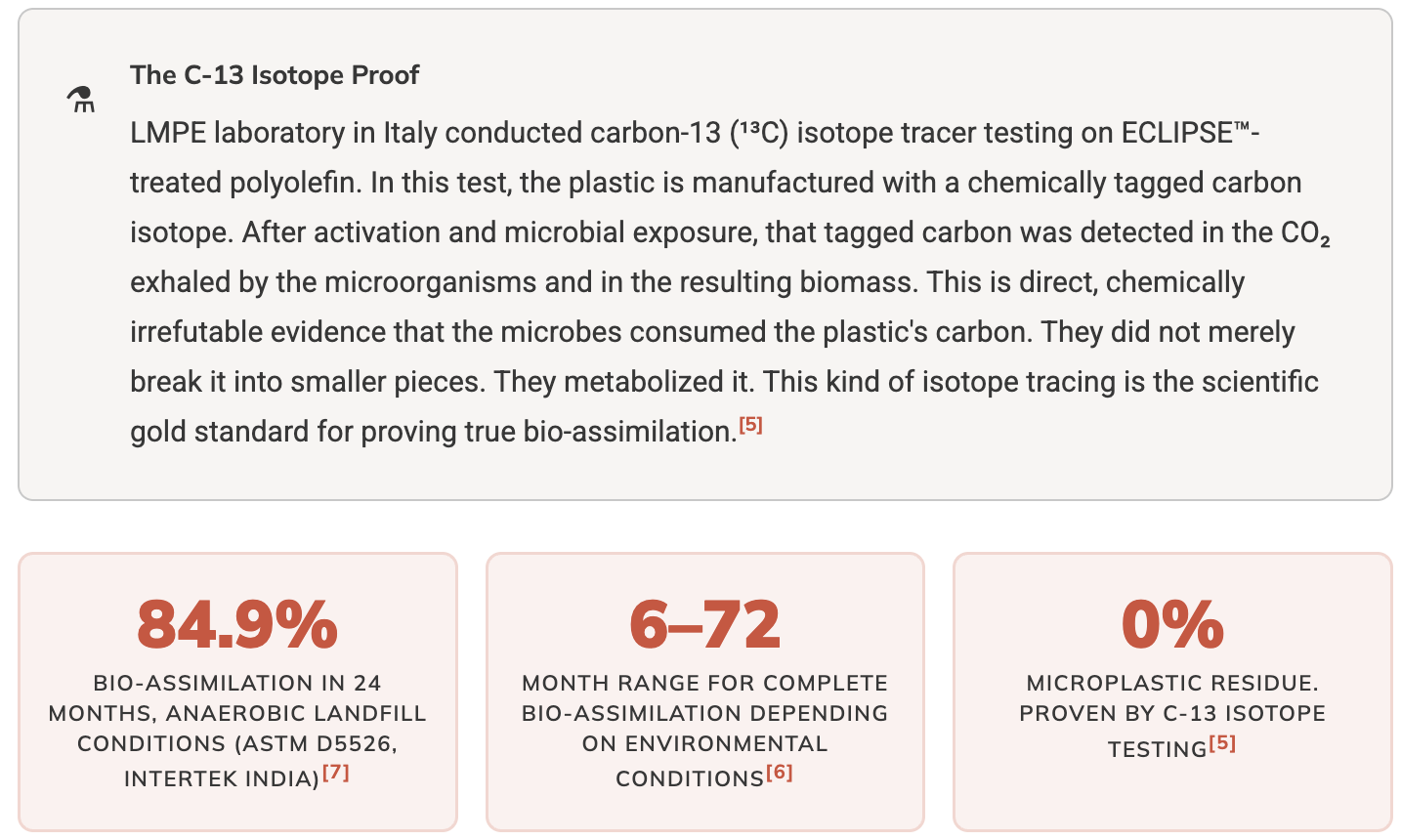
SPTek ECLIPSE® achieves bio-assimilation through a precisely engineered, two-stage process. The science behind it is validated by independent laboratories including Smithers, Intertek, LMPE Italy, TCKT Austria, and SEVAR France, and it is supported by isotopic tracer testing that proves with chemical certainty what is happening at the molecular level.[5]
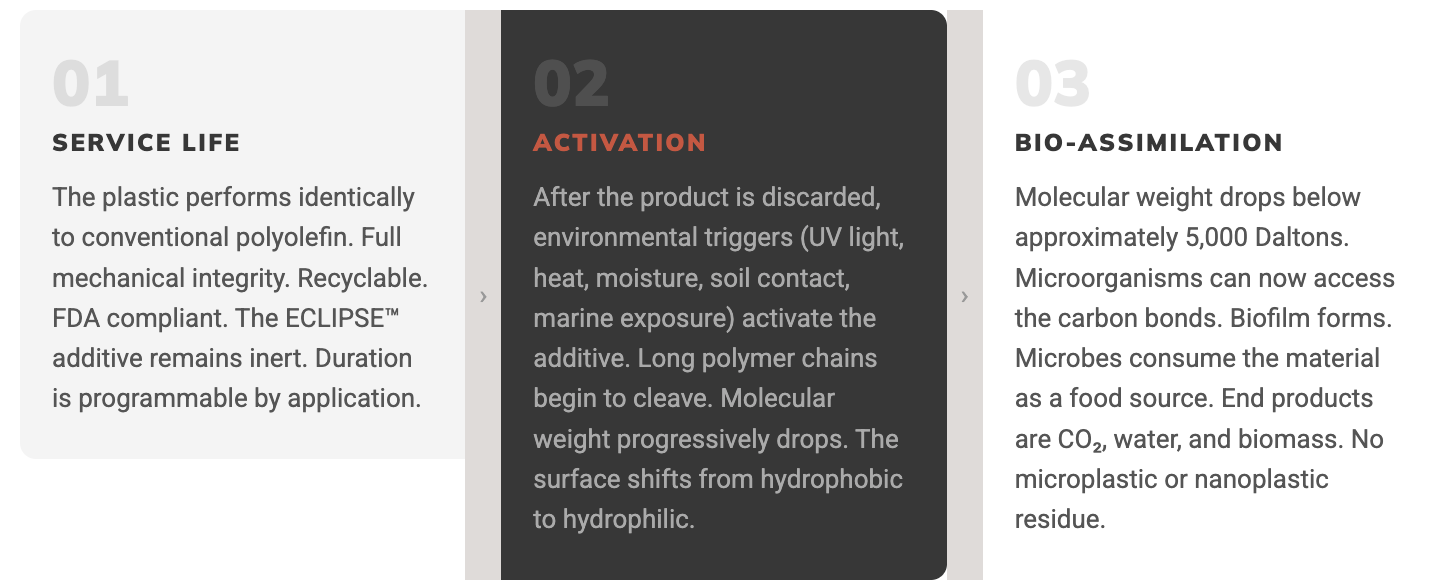
The distinction between Stage 2 and Stage 3 is where ECLIPSE® diverges fundamentally from oxo-degradation. Oxo-degradation stops at Stage 2. The polymer is fragmented but not consumed. ECLIPSE® is specifically engineered to move through Stage 2 and complete Stage 3 fully. The additive does not merely break the plastic apart. It prepares the material for biological consumption and ensures that consumption actually occurs.[6]
Side by Side
Precision Matters
The term "biodegradable" has been so broadly and loosely applied across the plastics industry that it has effectively lost meaning. Products have been labeled biodegradable that only degrade under industrial conditions, that leave behind microplastic fragments, or that simply have no credible testing to support the claim. Regulators in the EU, the UK, and the United States have all moved to restrict or scrutinize the term.[4]
Smart Plastic Technologies uses the term bio-assimilation because it describes a specific, testable, and validated outcome: the biological consumption of the plastic's carbon by living organisms, resulting in complete molecular conversion and no residue. This is not merely better marketing language. It is a scientifically precise description of a process that has been independently verified through isotope tracing, anaerobic digestion testing, UV-thermal aging studies, and long-duration respirometry assays conducted between 2016 and 2024 across multiple laboratories on three continents.[5]
Key technical distinction approved by Smart Plastic Technologies: "The generation of microplastics is a required phase in the journey towards complete bio-assimilation. SPTek ECLIPSE® proprietary technology enables completion of full bio-assimilation beyond the microplastics stage." This is the critical threshold no competitor has cleared.
No other additive-based technology currently on the market has demonstrated, through C-13 isotope tracing, complete microbial consumption of polyolefin carbon across aerobic and anaerobic environments without requiring infrastructure change, cost premium, or performance compromise. That is the scientific foundation of the ECLIPSE® claim, and it is why the language is used with precision and backed by a complete evidence file available at changetheplastic.com/science.[6]
Trellis’s annual list goes beyond a simple shoutout. Selected startups get profiled on Trellis.net, pitch in webinars to climate executives and investors, and compete for Startup of the Year at Trellis Impact 26 in San Francisco.
Smart Plastic Technologies is honored to be selected as one of Trellis’s 15 Climate Tech Startups to Watch in 2026. This recognition highlights early-stage innovators in categories like material innovation, where Smart Plastic fits perfectly with our SPTek ECLIPSE® platform.
Trellis’s annual list goes beyond a simple shoutout. Selected startups get profiled on Trellis.net, pitch in webinars to climate executives and investors, and compete for a shot at 'Startup of the Year' at Trellis Impact 26 in San Francisco. Community voting helps determine finalists at the May 27 webinar pitches, creating real momentum for deployment-ready solutions like Smart Plastic's ECLIPSE®.
For climate tech, this visibility accelerates partnerships with operators, buyers, and funders who prioritize traction over hype. It is especially timely as investors wrote $40.5B in checks to proven climate startups last year.
Plastic has revolutionized packaging, agriculture, and consumer goods, but recovery rates reveal a stark reality: most plastic escapes current systems. Recycling is essential but insufficient on its own. That is where permanent pollution risk grows.
Smart Plastic was founded on a simple belief: plastic should not become permanent pollution. Our SPTek ECLIPSE® additive is designed to work with conventional polyolefins (PE and PP), preserving performance and recyclability during use (timed and programmable) while supporting a better end-of-life outcome if recovery fails. Independent testing validates this approach across marine, terrestrial, and anaerobic landfill environments, with no microplastic residue.
Unlike solutions demanding infrastructure overhauls, ECLIPSE® is a drop-in additive at 1% inclusion — no retooling, FDA-compliant (GRAS), and compatible with existing extrusion processes. It addresses the gap in polyolefin packaging like stretch film, bags, and agricultural mulch, where leakage is common.
This practical design makes it deployable now, aligning with Trellis’s focus on Seed-to-Series A companies with real traction. Our $1.1M+ in sales through Q1 2026 and partnerships like Sigma Plastics prove the model works.
Public support shapes the finalists announced in May, setting up webinar pitches and a shot at Trellis Impact 26. If you believe plastic should be engineered with its full lifecycle in mind — performance first, then a responsible end — we'd sincerely appreciate your vote for Smart Plastic!
Thank you for supporting climate tech that is science-led, operationally realistic, and ready to scale. Let’s build a smarter standard together.
Smart Plastic Technologies develops materials solutions designed to improve plastic end-of-life outcomes. Its platform, including SPTek ECLIPSE®, is built to work with conventional polyolefins while supporting a more responsible path when plastic is not recovered. Learn more at changetheplastic.com.

The global disconnect around plastic end-of-life isn’t a failure of awareness. It’s a failure of system design.
Over the past decade, the burden of solving the plastic problem has been placed on individuals: recycle more, choose better, avoid single-use wherever possible. Yet, plastic production continues to rise, and waste systems continue to fall short.
That disconnect isn’t a failure of awareness. It’s a failure of system design.
Much of our current approach depends on a simple assumption: if consumers do the “right” thing by recycling or composting materials, the system will work. But globally, only about 9% of plastic is actually recycled, highlighting the limits of downstream solutions alone.
Recycling systems are constrained by economics, contamination, and inconsistent infrastructure. Compostable materials depend on facilities that don’t exist in many regions. Even well-labeled packaging often ends up in the wrong wastestream.
We’ve designed solutions that depend on ideal conditions and placed them into systems that are anything but ideal.
The scale of the issue makes this even clearer. More than 350 million tons of plastic are produced annually, and two-thirds become waste within five years or less. This is not just a waste management problem, it’s a throughput problem.
We’ve optimized for speed, cost, and convenience, but not for recovery. Even when waste is collected, a significant portion is not recycled. In packaging — the largest source of plastic waste — much of what is collected still ends up in landfills or incineration due to technical and economic barriers.
Much of today’s response focuses on what happens after plastic becomes waste: recycling, recovery systems, and even offset mechanisms like plastic credits. These efforts are important, but they are inherently limited. They depend on infrastructure that is inconsistent and underdeveloped, economics that are often unfavorable, and human behavior that is difficult to standardize at scale.
As a result, even well-designed materials frequently fail to achieve their intended outcomes. By the time plastic reaches the waste stage, the conditions for success have already been constrained. Managing waste is necessary, but it cannot, on its own, solve a system that was not designed for recovery in the first place.
But a shift is coming. Extended Producer Responsibility (EPR), which requires producers to take accountability for packaging after use, is rapidly becoming central to global policy and circularity efforts. Already, dozens of jurisdictions worldwide are implementing or developing EPR frameworks, fundamentally shifting accountability upstream.
The question is no longer just: Is this recyclable?
It is now: What actually happens to this material in the real world — and who is responsible for that outcome?
End-of-life is no longer a secondary consideration. It is becoming a design constraint.
Plastic is often framed as the problem itself. And I wholeheartedly agree that reducing unnecessary plastic use is critical. But plastic didn’t become dominant by accident; it persists because it works within global supply chains, food systems, and cost structures.
It is lightweight, durable, cost-effective, and highly adaptable. It fits the system we’ve built. Even global institutions recognize this duality: plastic is deeply embedded in modern economies, even as its environmental impacts accelerate.
Which raises a more useful question:
If plastic is a problem, what does that say about the system that made it indispensable?
At the same time, emerging solutions like reuse, while promising, face their own constraints. Scaling reuse systems depends heavily on infrastructure development and cost competitiveness, which are still evolving.
We are still trying to solve the problem after the fact, rather than addressing how materials behave within real-world systems from the start.
If responsibility is shifting upstream, and systems remain imperfect, then the bar for solutions must change. It is no longer enough for materials to perform well in theory. They must perform in reality.
That means accounting for incomplete infrastructure, inconsistent behavior, leakage across waste streams, and economic constraints.
As regulatory pressure increases and margins tighten across the packaging industry, solutions that cannot meet cost, performance, and system constraints will struggle to scale.
If we continue to rely on downstream behavior to solve an upstream design problem, we will continue to fall short.
This is where the conversation is evolving — from intention to outcome, from design to accountability, from recyclability to real-world performance.
The real challenge is building systems, and solutions, that work as they are today, while moving us toward something better.
The goal isn’t just to eliminate plastic. It’s to build a world where we no longer depend on it in the ways we do today. That will require reducing unnecessary material use, accelerating viable alternatives, investing in infrastructure, and designing materials that align with real-world conditions.
Because until systems, incentives, policy, and design are aligned, we’re not solving the plastic problem. We’re just managing its symptoms.
Sources:
https://www.weforum.org/stories/2025/01/tipping-point-year-for-reusable-packaging-systems/
https://www.pew.org/en/research-and-analysis/reports/2025/12/breaking-the-plastic-wave-2025

Tim Murtaugh founded Smart Plastic Technologies on the belief that plastic did not have to become permanent pollution. He gave that belief a company, a science, and a team willing to fight for it.
Tim passed away suddenly on March 17, 2026.
There are founders who build companies, and there are founders who build cultures. Tim understood that the two are not separate projects. He knew that a mission as serious as changing how the world thinks about plastic would require more than good science. It would require people who trusted each other, who could disagree with respect and civility, and who came back the next morning ready to try again.
That is the company he built. And that is the company that will carry his work forward.
Tim was a serial entrepreneur. He grew up in upstate New York and spent a good part of his childhood in foster homes. He knew adversity, and it was likely in this crucible that his unquenchable fire for life and people was born. He knew he was meant to do important work, and he did, founding a beloved non-profit ministry for boys and a successful real estate development company, among others.
Tim was not interested in noise. He believed in precision: in claims that could be defended, in science that could be verified, in promises to customers and investors that could actually be kept. He pushed the team not to be louder, but to be more honest and more rigorous. In a market full of easy shortcuts and greenwashed language, that discipline was his signature.
He mentored the people around him without making it feel like mentorship. He asked questions when most leaders would have given answers. He listened when most people would have moved on. He was tough when he needed to be but always fair, with a ready smile and a bright outlook. He was a glass half full kind of guy.
The mission he founded Smart Plastic Technologies to pursue has not changed. If anything, it matters more now. We will honor him by seeing it through.
To Tim’s family:
We are grateful for every minute he gave to this team and to this work, and we are profoundly sorry for your loss. Tim’s name and his way of leading will remain a part of us and of this company for as long as it stands.
The Smart Plastic Technologies Team
March 2026

For over 70 years, plastic hasn't evolved. Now, with SPTek ECLIPSE®, Smart Plastic Technologies has introduced a 1% drop-in additive for polyolefins that preserves performance and processing, stays compatible with recycling pre-activation, and adds an end-of-life safety net.
Click here to see our latest video describing how SPTek ECLIPSE® is The Last Plastic.
https://youtu.be/yvTYkC4nL_8?si=c8GWqlhzGzuY2jXZ
This is a plastic bag. Simple. Useful. Disposable. And part of the 400 million tons of plastic produced every year.
Globally, less than 10% is recycled — polluting our land and water… our food supply… even our bodies. So, we created a failsafe for when plastic ends up in our environment.It’s called Smart Plastic – and it’s designed to disappear on purpose.Here’s how it works: Our SPTek ECLIPSE® additive gives plastic a functional life span.
180 days… 24 months… 7 years… Manufacturers decide based on the product — with no changes to machinery, no new equipment, no disruption.
When a product’s useful life is over — whether it ends up in sunlight, soil, landfill, or ocean, heat and humidity trigger the programmed transformation.
Long polymer chains fracture into shorter segments. But unlike other so-called “degradables” that leave behind microplastics, Smart Plastic keeps going… reducing segments to a size small enough for microbes to recognize as food… converting the plastic into water… CO₂… and biomass — the same material all living organisms are made from. No toxins. No microplastics. No greenwashing.
And this isn’t just theory. We’re proving it every day.
We’re adding ECLIPSE® to industrial stretch film… medical device packaging and surgical gowns… agricultural mulch film… food packaging and straws… and the grocery bags holding your produce. And that’s just the beginning. Plastic hasn’t evolved in 70 years. Now is the time. Across industries and applications, Smart Plastic is reshaping what plastic can be.Proven chemistry. Predictable performance. A cleaner planet.
This is the new Smart Standard™. SPTek ECLIPSE® by Smart Plastic. Plastic that Disappears on Purpose. changetheplastic.com
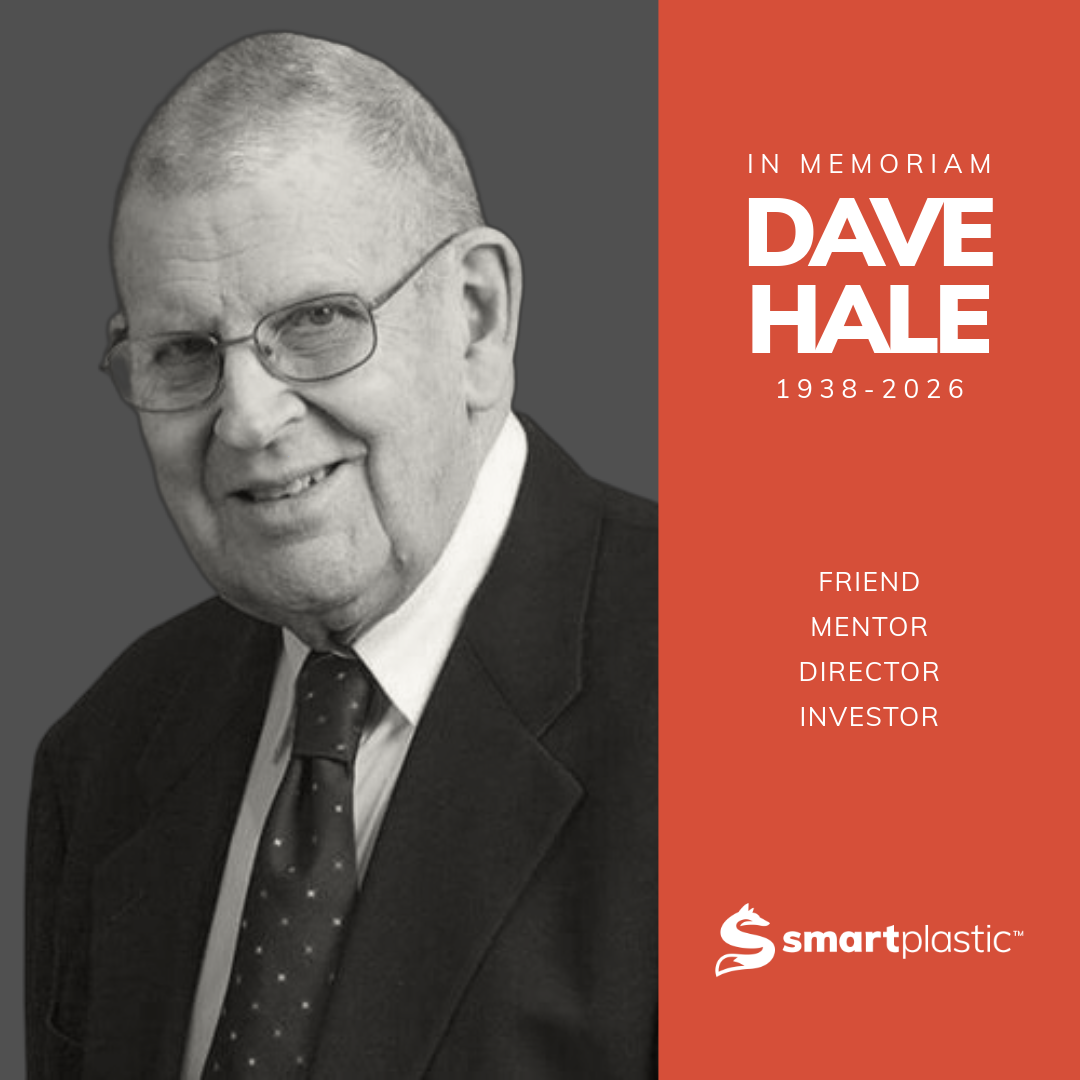
"Occasionally, as we tread through life, we are blessed with the opportunity to meet someone who is truly exceptional. I had the pleasure of the gift of Dave Hale’s friendship. Not just a man, Dave was a giant when it came to caring about others. From neighbors to co-workers and employees, Dave’s instinctive mission was to make things better for others. Humble philanthropist, creative thinker, hard worker, ethical friend. What more can I say? He will be greatly missed." — Tim Murtaugh, CEO, Smart Plastic

Smart Plastic’s SPTek ECLIPSETM technology is a crucial safety net should plastic products evade the recycling system. Following a guaranteed functional life span, packaging has been shown to degrade up to 63% in 6 months under simulated landfill conditions.
By comparison, conventional plastics are not considered biodegradable. (As verified by ASTM D5526 test).